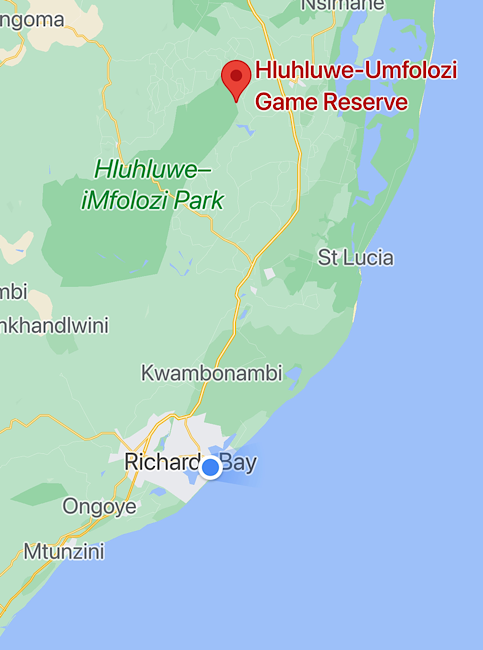
Tuesday November 9, Day trip to Hluhluwe (sh-lew-sh-lew-we) Imfolozi Game Reserve. It is a Big 5 Game Park in the KwaZulu Natal Region of South Africa. The oldest reserve in Africa, 96000 hectares of Wilderness.
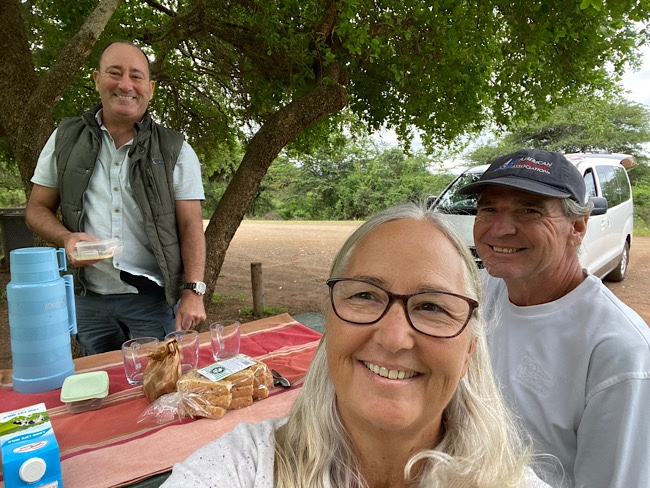
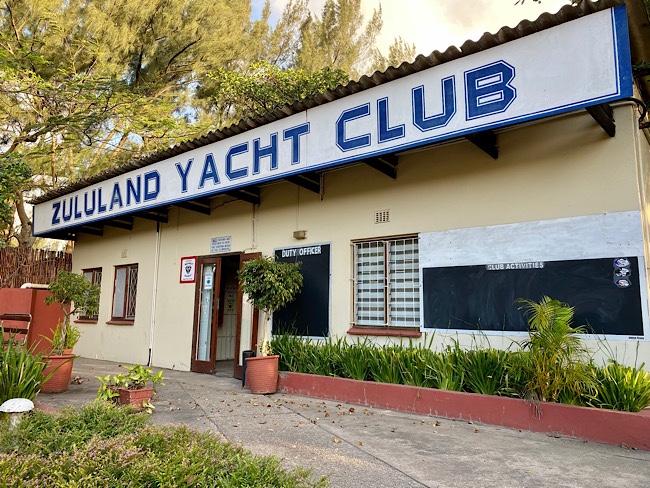
Our guide was Hayden Elliot from Outdoor Africa , he was extremely knowledgeable about the animals, plants and birds we saw as well as the park and South African history. Hayden picked us up from Zululand Yacht Club in a comfortable van where the second seat windows opened to the side for photo opportunities. Included in our tour was a mid-morning coffee/tea and biscuits break in the park, as well as a delicious lunch early afternoon, at a picnic table with Impalas and Zebra roaming nearby.
The weather was not ideal, it was chilly, and very windy with a few rain sprinkles. With a lot of searching, we did see 4 of the Big 5 animals, African Buffalo, Elephant, Rhinoceros, Lion and several other species. The fifth being the Leopard, a nocturnal animal is typically seen at night or sunrise if you’re lucky. They are called the Big 5 as these five large African animals are known to be dangerous and historically considered a triumph by trophy hunters.
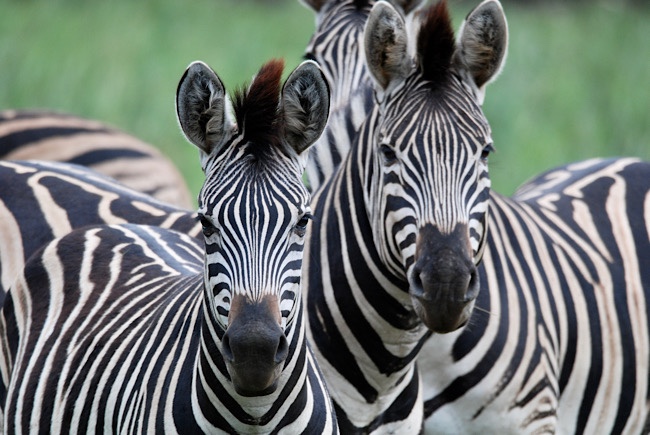
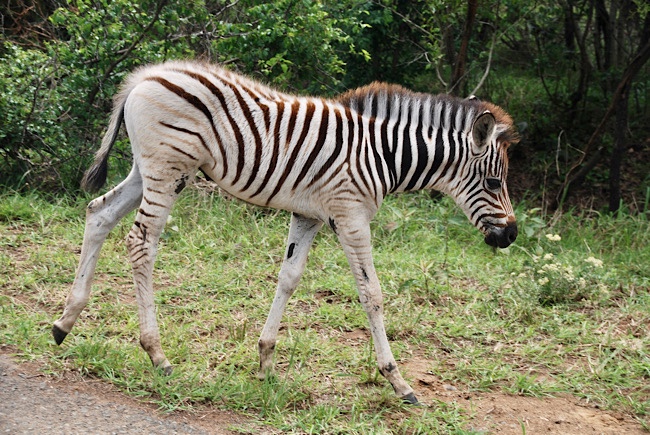
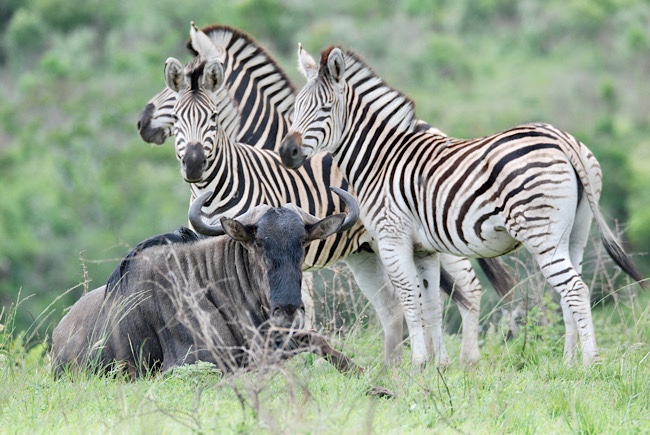
Zebras
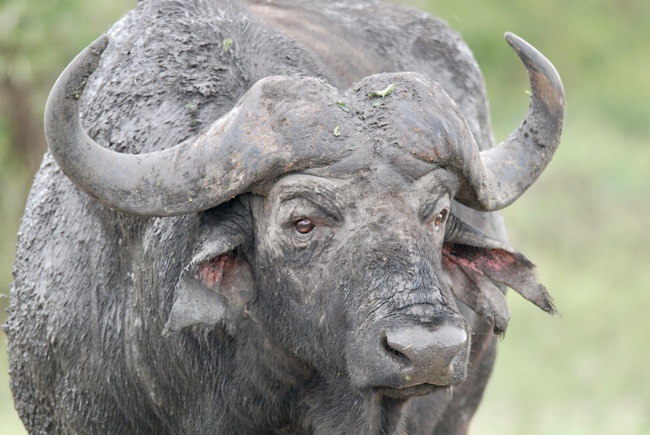
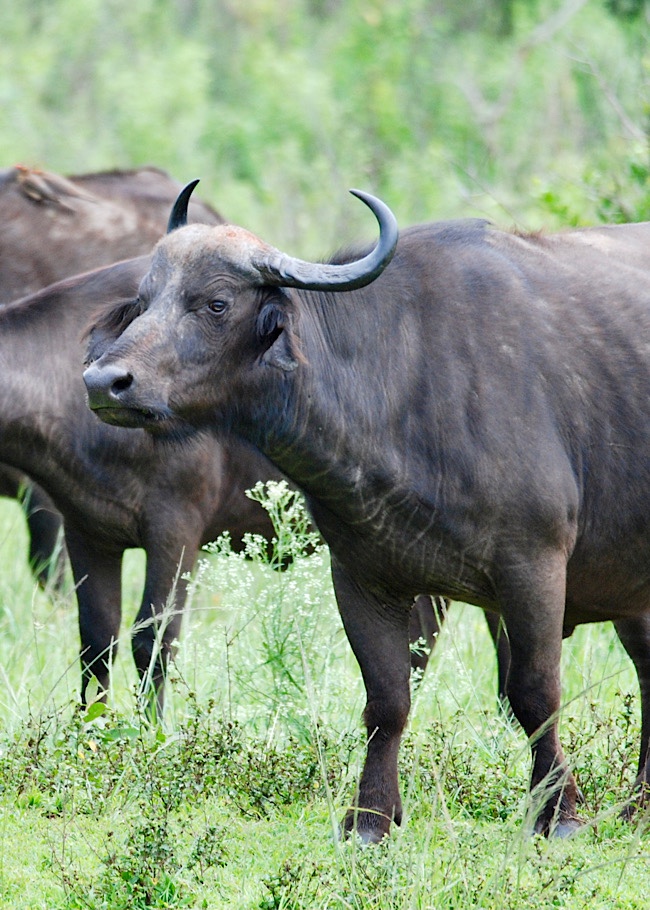
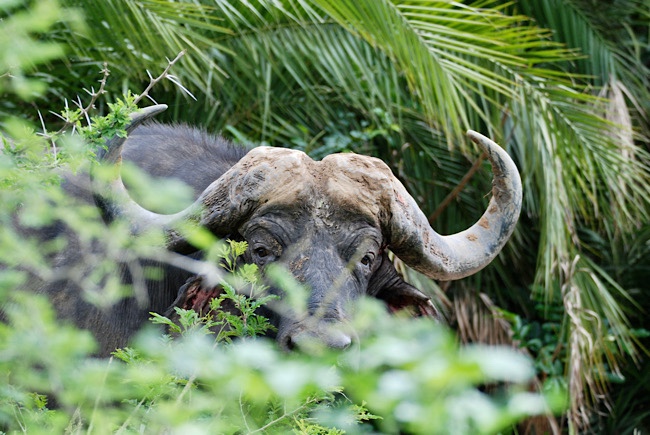
African Buffalo
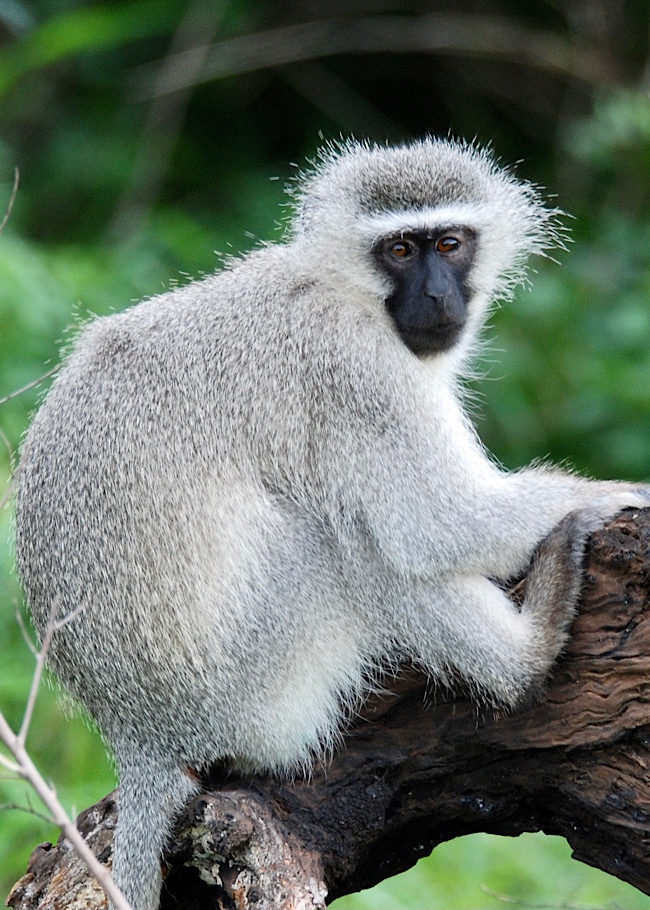
Vervet Monkey
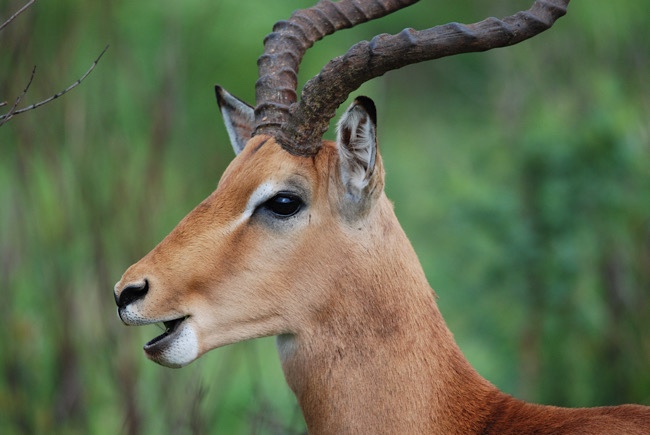
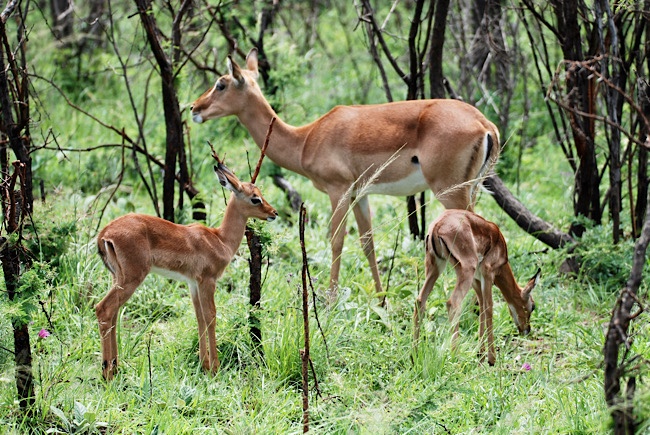
Impala, males have horns
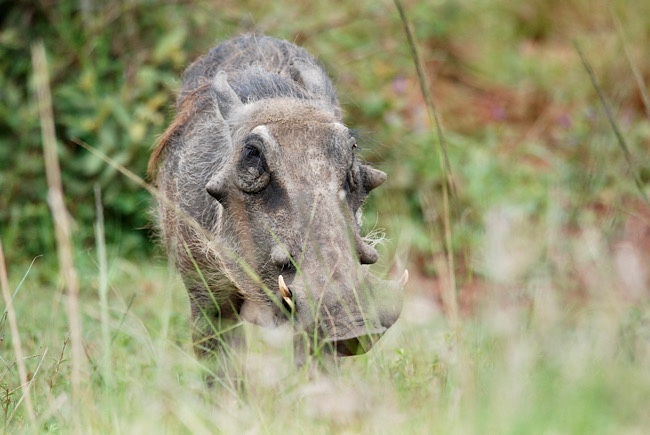
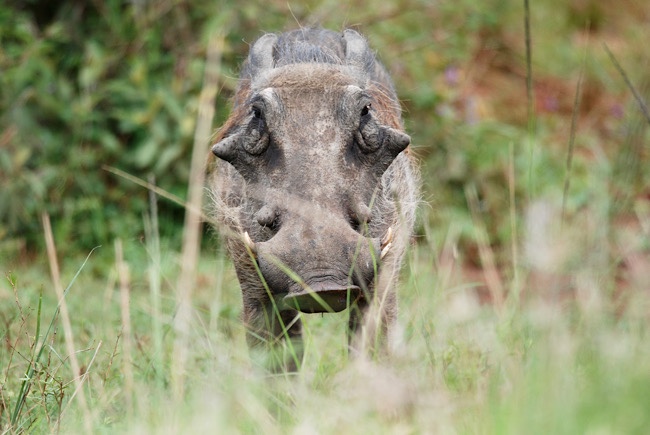
Warthog
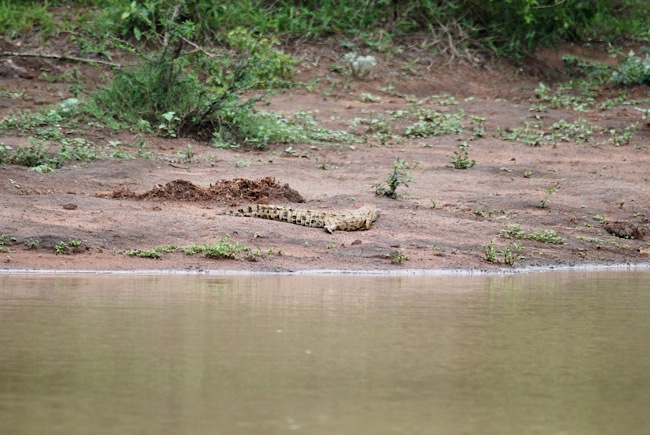
Crocodile
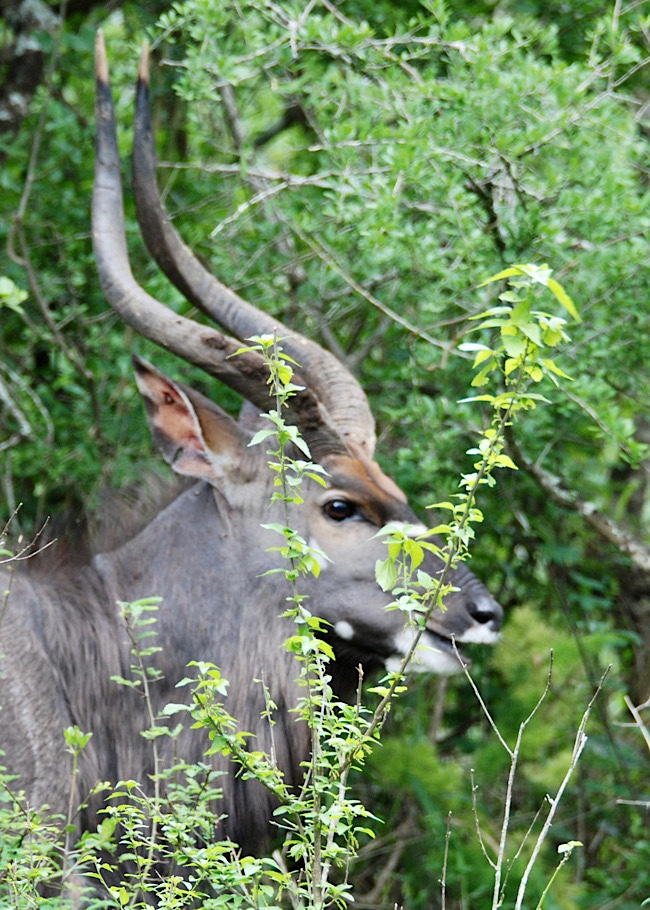
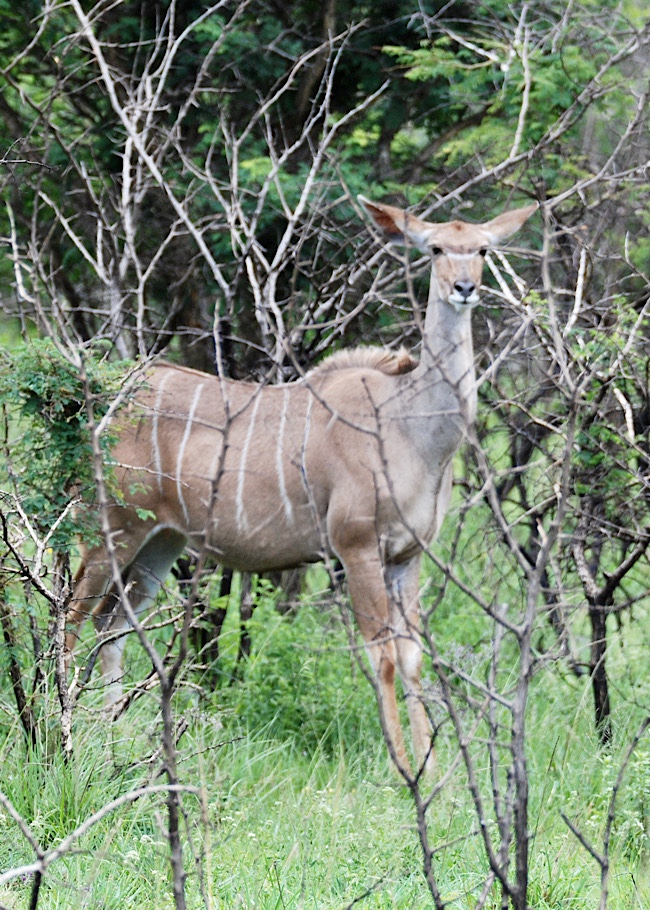
Nyala, male is the dark gray with horns, females are light brown
African Wattled Lapwing, about 14 inches tall.
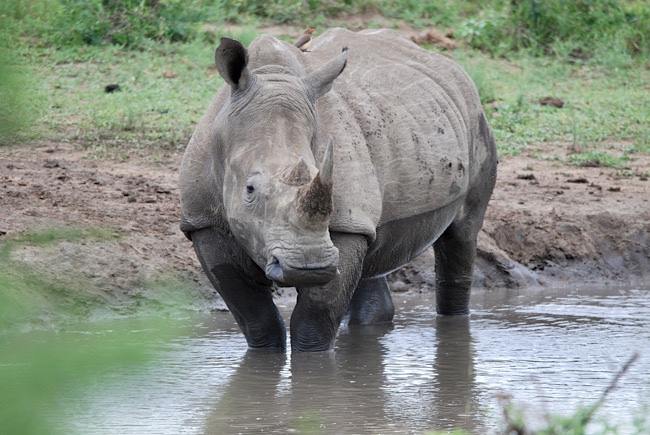
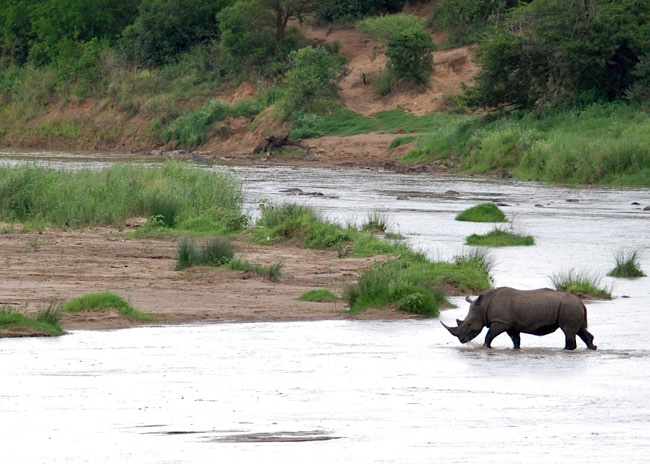
White Rhinoceros. Subject to poaching for its horn. Within the reserve we saw armed anti-poaching patrols.
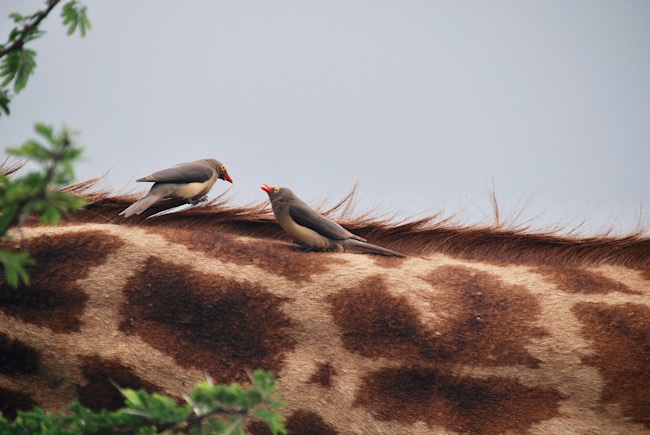
Giraffe. Red Billed Ox Pecker birds, they are about 8 inches in length. The birds cling to cattle and big-game animals to remove ticks, flies, and maggots from their hides. When the birds are alarmed, they hiss, alerting their hosts to possible danger in the area such as a predator.
Little-Bee Eater, native to South Africa, they hunt insects whilst in flight. They are 6 inches in length.
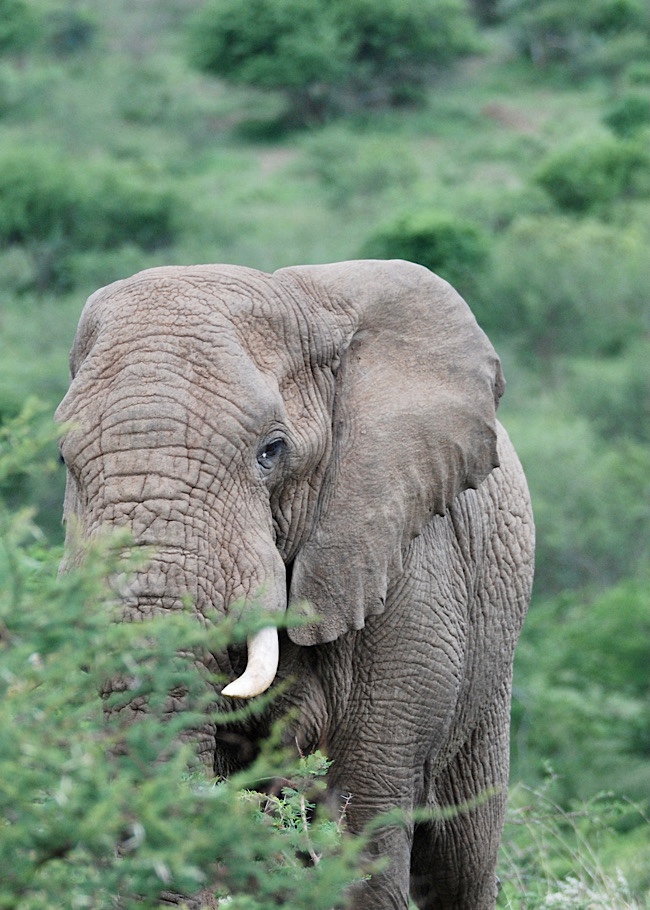
Elephant
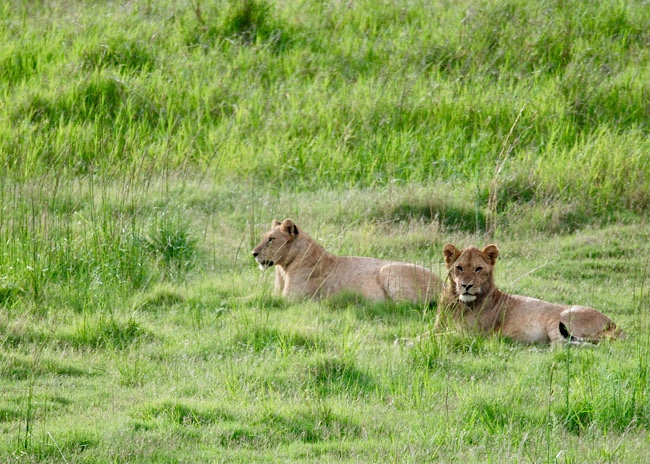
Female on the left, young male on the right
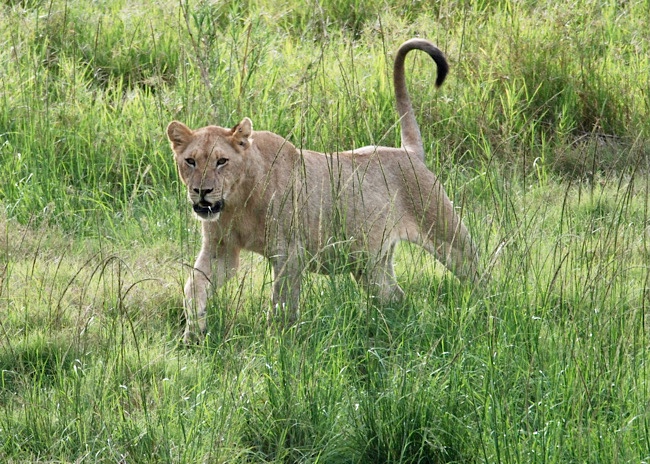
Lion. She did not like us being there, started walking and roaring as if she was alerting other lions of our presence. Hayden mention during his 20 year career, this was the fourth time he’d heard a lion roar.
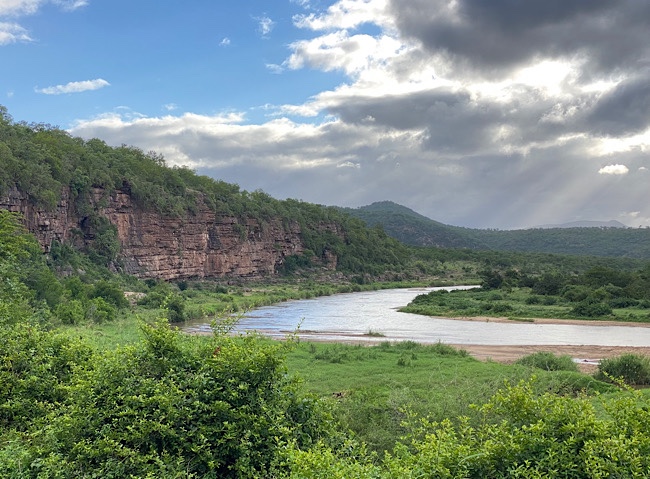
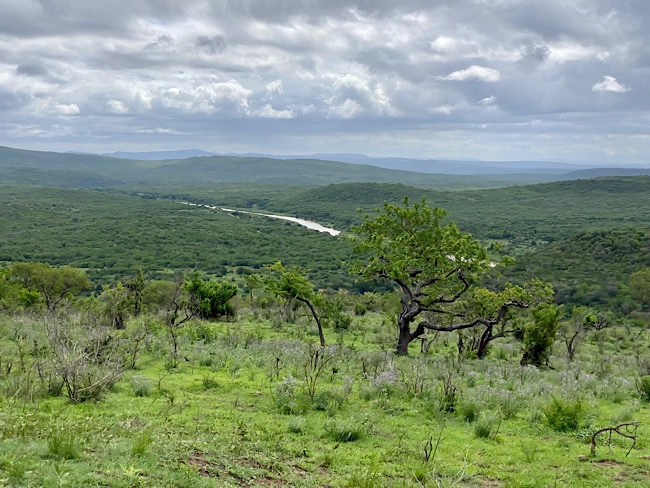
White Umfolozi River
Wallows or watering holes are natural depressions that hold run off water. There are several throughout the park.
Monday November 8, Eric is a local club member who will drive you around town, for a fee, instead of getting a taxi. He is well known throughout the club and his service is used by many cruisers. Along with Mark and Susan from s/v Erie Spirit (from Toledo, they’ve been cruising for 11 years), Eric dropped us off at the mall, the Boardwalk Inkwazi Shopping Center. Known as “the Heart of Zululand”, it has over 160 stores.
In the evening there was a meat and greet Braai (barbecue over wood or charcoal) sponsored by ZYC, Ocean Sailing Association of South Africa (OSASA) and Ocean Cruising Club (OCC).The event was for all the “International Yachties” that are here, about 20 boats.
Jenny Crickmore- Thompson, Director OSASA
Natasha Wolmarans, Richards Bay OCC Port Captain
The OSASA was formed within the past couple years, by three South African cruisers. They streamlined the country check in process, creating an online portal to fill out and upload required documents. Cruising boats visiting South Africa has increased in recent years as the Red Sea route has mostly been avoided due to pirate activity. Around the world sailboat races also include a stop in South Africa.
The OCC, administered from the UK, is an international club promoting long-distance cruising. Membership is open to anyone either as skipper or certified as competent by the skipper, who has completed a continuous ocean passage of at least 1000 miles, measured along the rhumb line, in a vessel of under 72 feet. The Ocean Cruising Club maintains a network of over 100 Port Officers worldwide to assist members.
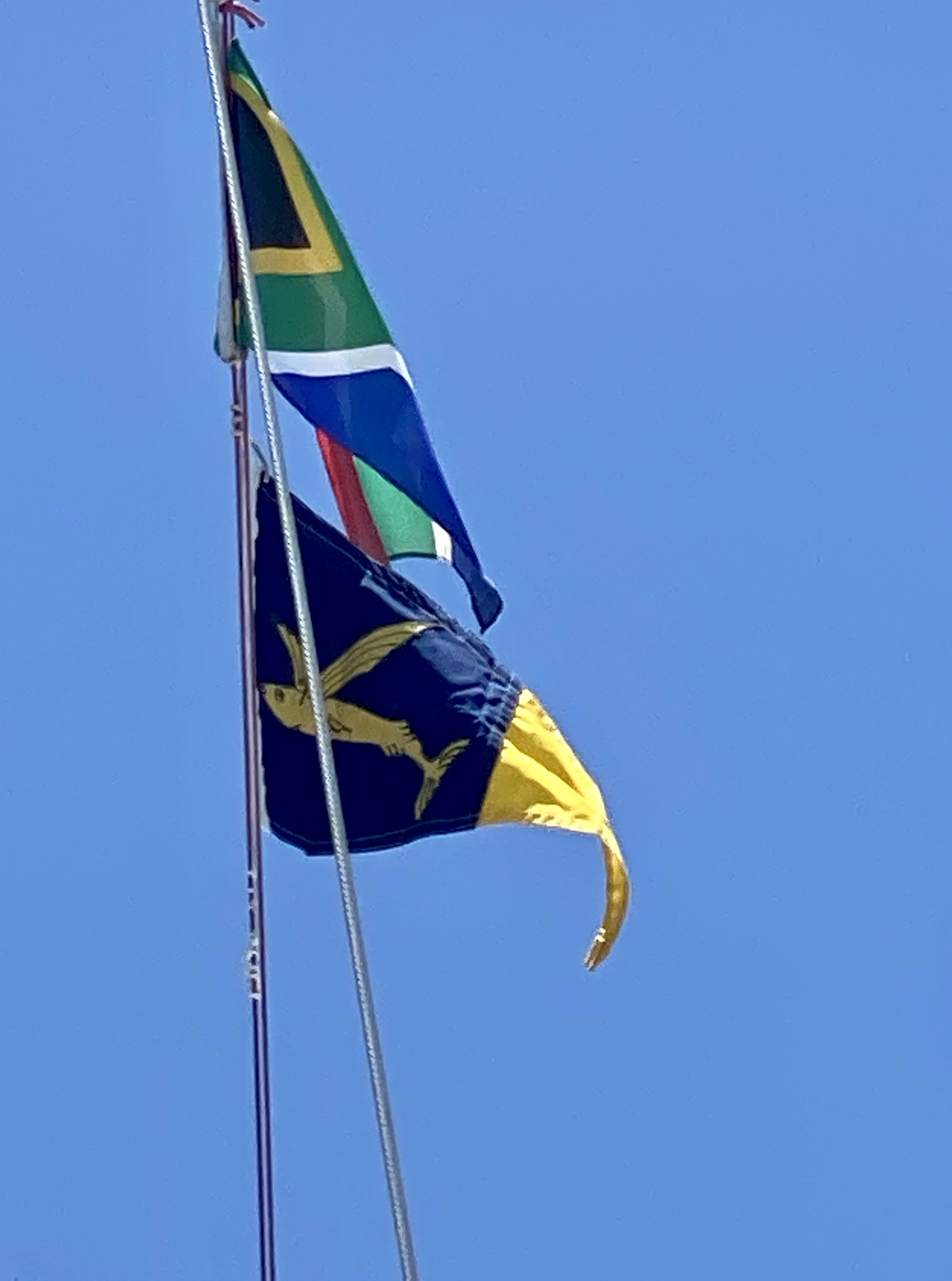
Our OCC flag flying below our South Africa courtesy flag.
Tuesday November 9, day trip to Hluhluwe Game Reserve (see separate post on the adventure). On the ride there our guide, Hayden Elliot, pointed out a few things along the way.
Eucalyptus Trees, not indigenous to South Africa but introduced from Australia, are engineered to grow fast and straight, ready to mill in just seven years. There are over 450,000 acres of trees here. They are the most valuable and widely planted commercial plantation tree species in the world, with high pulping yields and low production costs. The downside is the trees threaten the valuable water supply.
Eucalyptus Trees
Rural Zulu village
Typical Zulu people rural houses. Polygamy is legal in South Africa, each wife has her own house within the compound. The circular houses belong to the Grandmother.
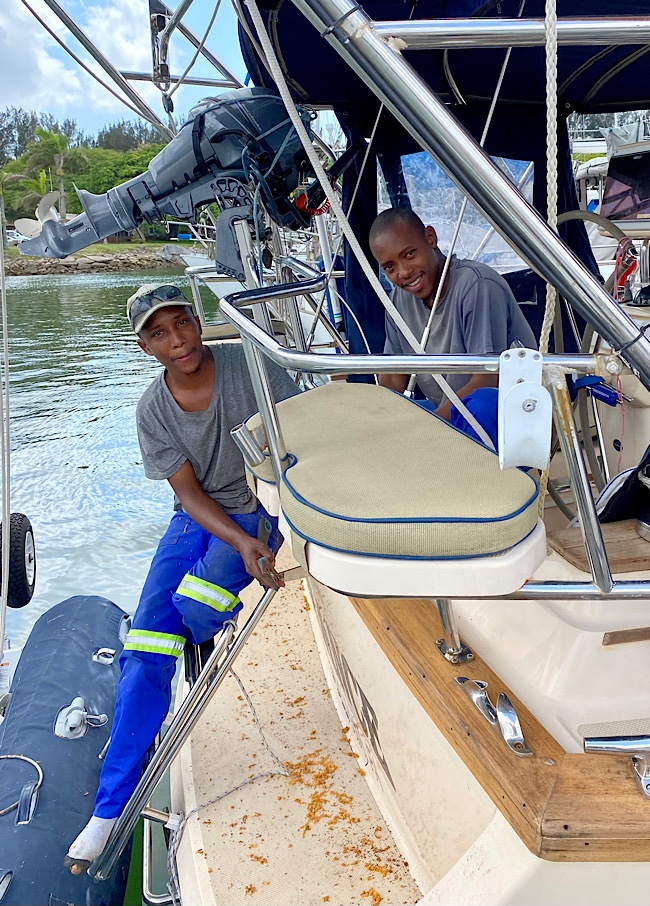
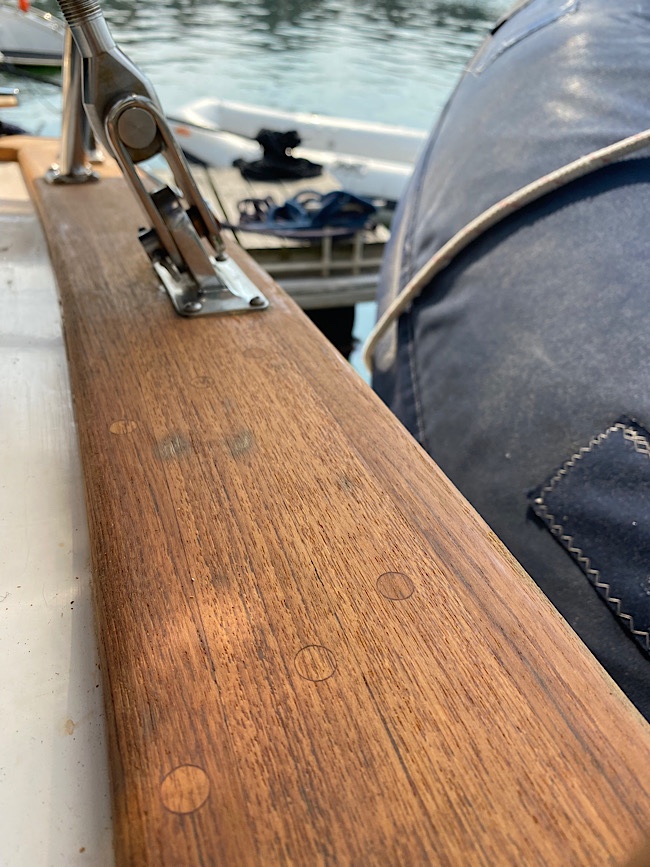
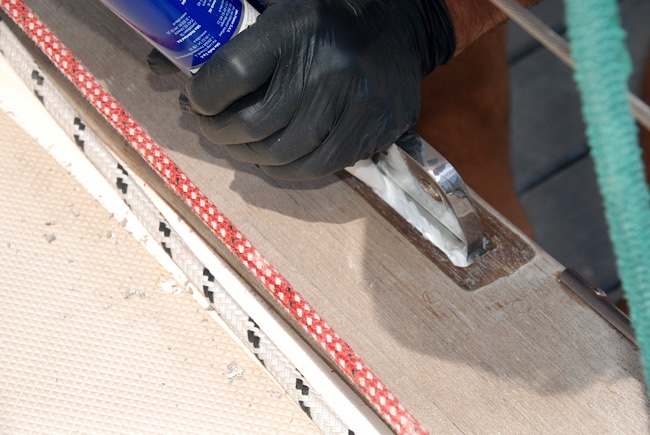
Wednesday November 10, we hired a local contractor to finish stripping the varnish off the teak cap rails. On the side of the cap there is a metal strip, we didn’t remove the varnish below that strip or on the transom.
Taped and ready to seal
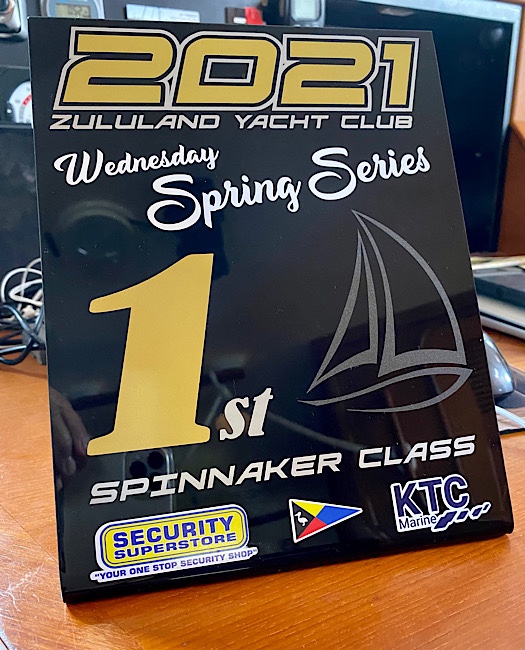
Dan was given this trophy.
Dan went racing again in the evening on a different boat, they finished first. Shorter race than Sunday, around the channel buoys, not a typical race course, it was a zigzag path.
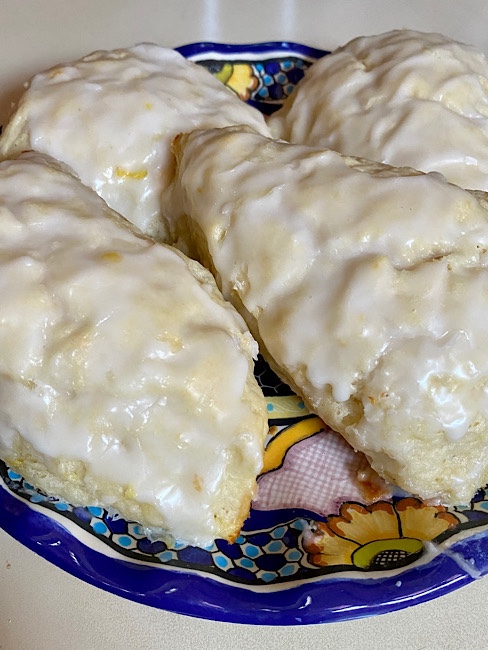
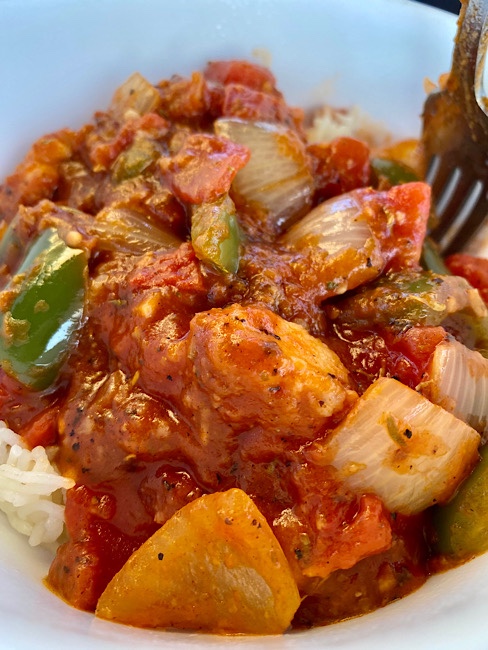
Thursday November 11, 🇺🇸 the work on the teak rails is almost complete. In the morning I baked lemon scones with lemon glaze. For dinner Curry Chicken, first time I made that, so good!
Lemon glazed Scones
Curry Chicken over Rice
Friday November 12, Teak rail on the starboard side and stern is completed. The port side is cleaned, needs to be sealed then metal trim put in place, rain delayed the process.
Teak on the transom
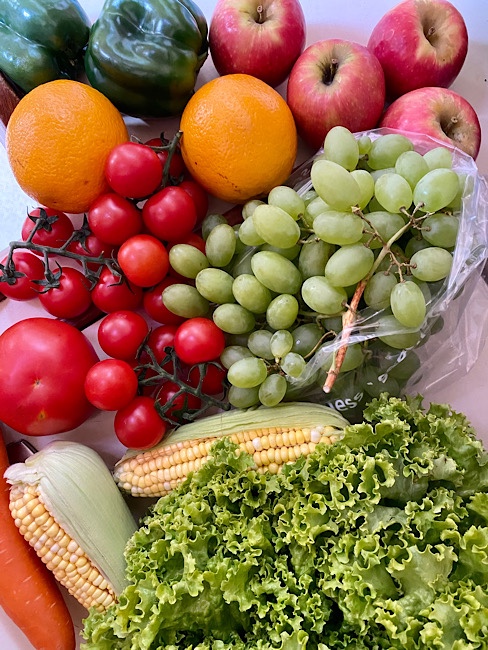
Saturday November 13, Eric took us to the mall, Dan got a hair cut, we did a little food shopping mainly for produce and chocolate! We found at least four large grocery stores in the mall.
Falbala arrived this afternoon. Their passage from Reunion Island was not great. A day away from South Africa, their boat was struck by lightning in a storm. They lost all electronics, but we’re able to arrive under motor. We stopped over Tuzi Gazi to say hello.
Didier and Magaly
Ohana is sailing to Richards Bay from Reunion, currently about 6 days away. Estran my be ready to leave by Friday, they are having their standing rigging replaced.
Sunday November 14, Blueberry pancakes for breakfast, with fresh blueberries!
Monday November 1, COVID test done, Health, visit from port Health Officer done… Oh, and the salt was washed off Trance today too. Still waiting….
COVID test
Immigration
Trance on the “Wall”at Tuzi Gazi
Tuesday November 2, gray chilly, windy day with rain in the forecast. Immigration arrived at the boat at 8:30 am, passports stamped! In the afternoon, we went to customs office to complete the check in process. Later we moved Trance over to the Zululand Yacht Club where we’ll stay a few weeks before continuing around the coast of South Africa.
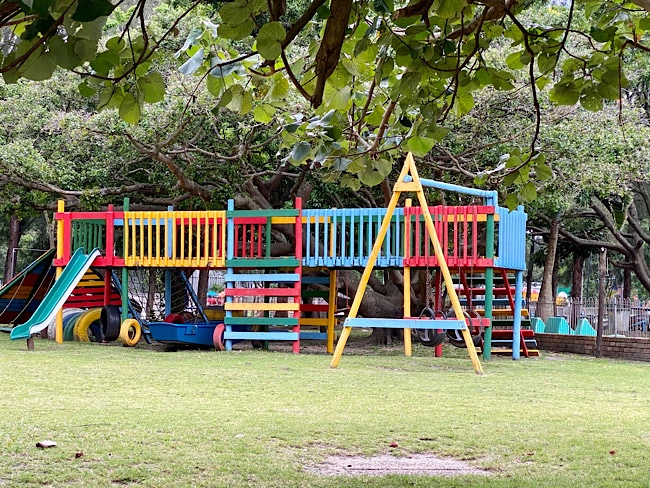
Playground , there’s an in ground pool behind
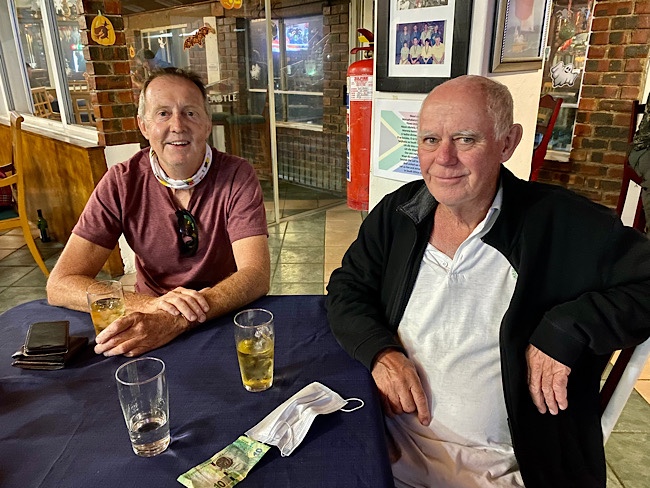
After walking around the club grounds, we stopped up in the Pelican Bar at the club. We met a few members, shared a couple drinks with them. Later went out to dinner with friends Simon and Jeff, it was a great night.
Simon and Jeff
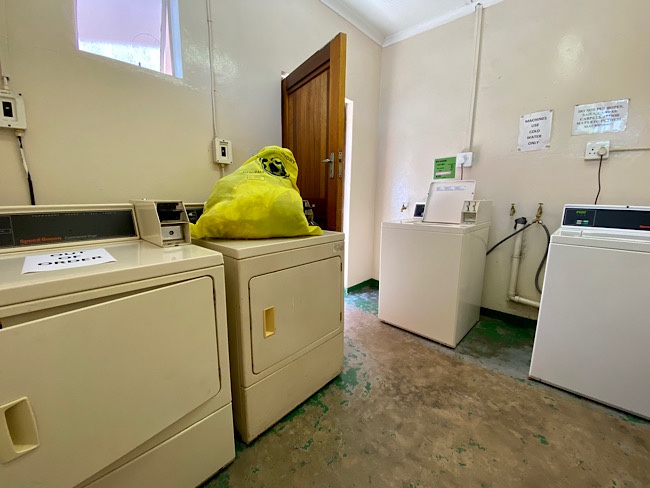
Wednesday November 3, laundry day
At the yacht club
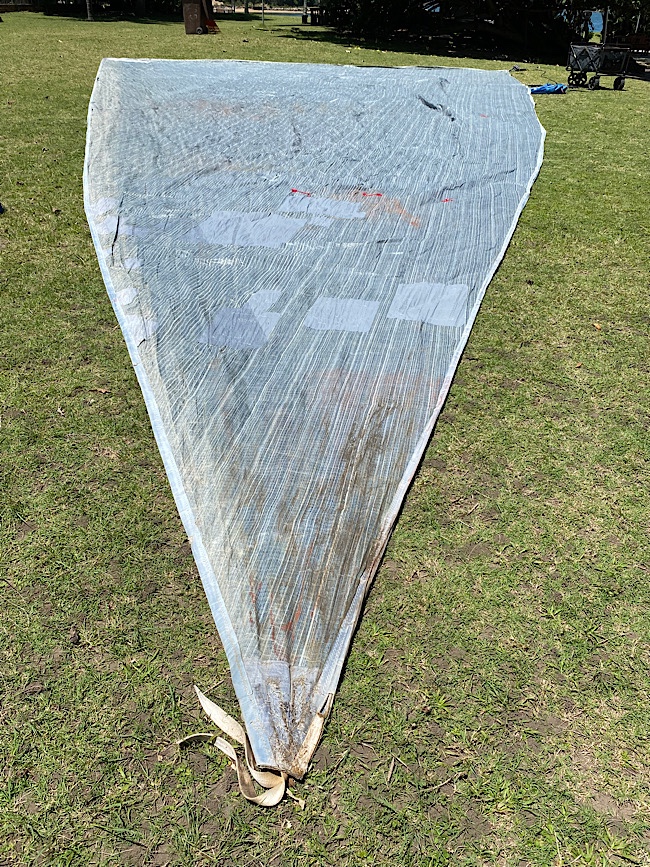
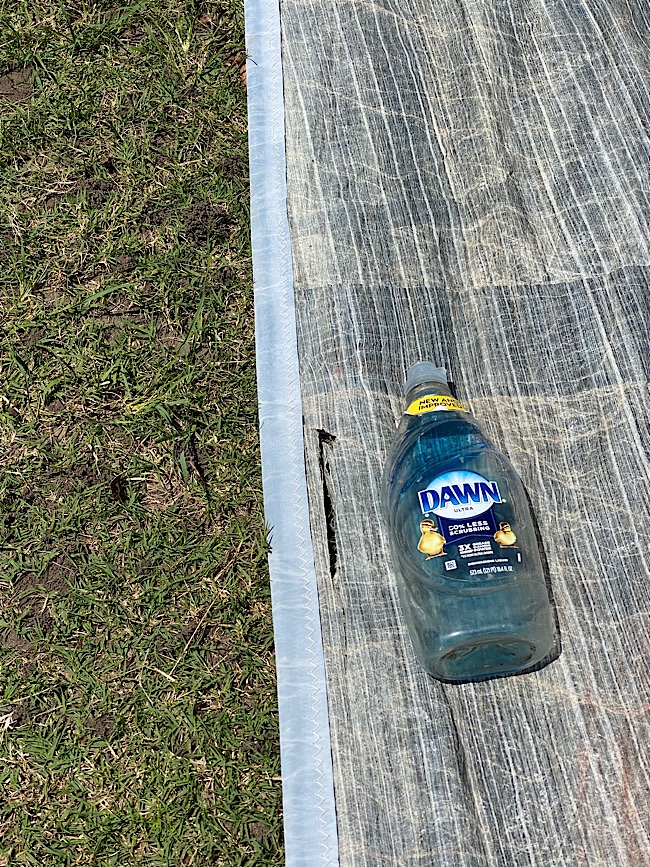
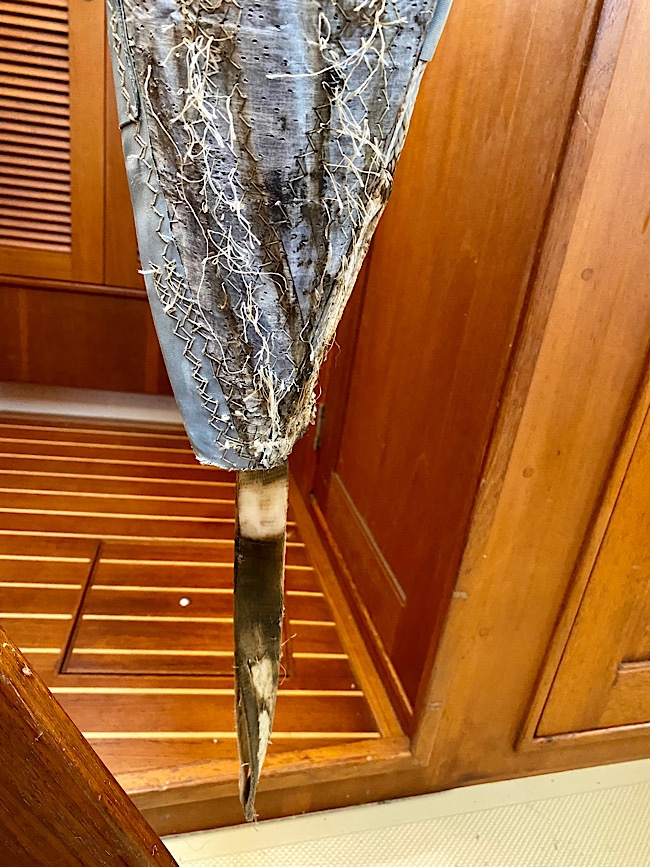
Another rant on our code sail. Cody is off to the North Sails loft in Cape Town to be looked at, hopefully it can be repaired there. How does a two year old sail that is barely used delaminate? Oh, and it tore, in two places, again along the leach line that has thinned (the foot has also thinned) where the Dacron luff tape is sewed, it supposedly has UV protection painted on the foot and luff. “3Di is stronger, lighter and more resistant to environmental factors than laminate string sails” says North Sails, not believing it!
The wide light edge on the left in the first two photos is where the sail material has thinned on the luff and foot.
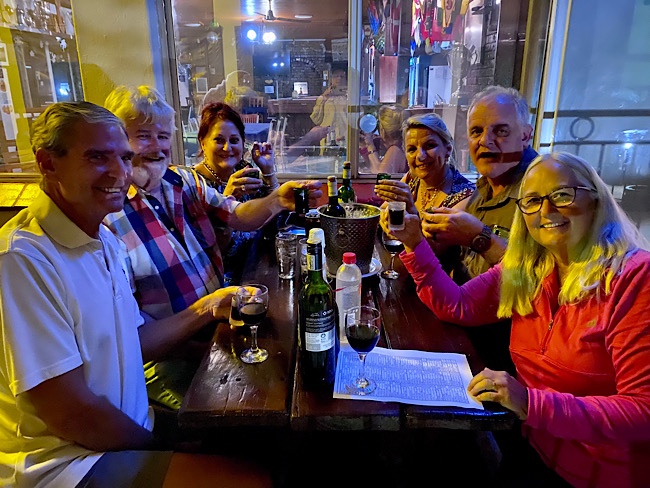
In the evening at the bar, every Wednesday they recognize the new international yachts that have arrived, presenting them with a bottle of champagne. This acknowledgment is just before they give awards for Wednesday night racing.
Dan, Guy, Linda, Me, Francois and Charlotte
New friends we met, local club members
Thursday November 4, Lunch with Michael and Priscilla from s/v Hylite. He’s from Australia she’s from Malaysia, however they lived in the US for many years. They departed on their journey in 2017 from San Francisco. In the evening we spent time at the bar with Jeff and Simon, they are leaving Friday.
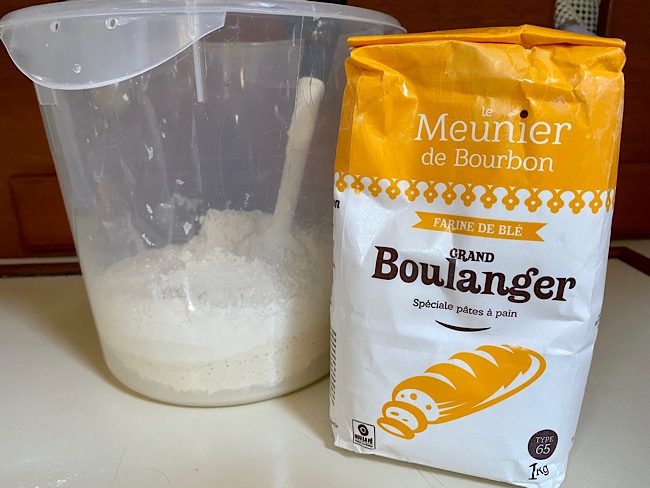
Friday November 5, * Sourdough Notes* I officially ran out of King Arthur bread flour. When we departed Hawaii I had 50 pounds of it on the boat. I purchased a few kilograms of a high protein flour T-65 on Reunion Island. My dough is wetter than with the KA, next loaf I should about 30% less flour. The bread turned out great with a nice oven rise.
Comedy night at ZYC was delayed an hour from a blackout. The show was funny, lots of “local” jokes, the crowed enjoyed it.
South Africa has an Energy Crisis. It is an ongoing period when South Africa experiences widespread rolling blackouts as supply falls behind demand, It began in 2007 and still continues. Load shedding is used to relieve stress on a primary energy source when demand for electricity is greater than that power source can supply, demand is distributed. Energy here is from coal burning.
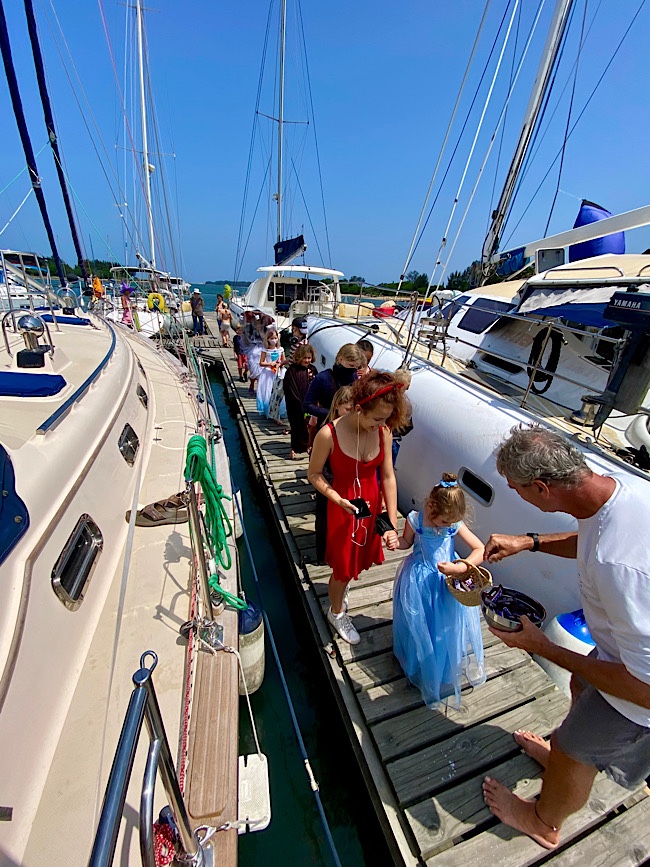
Saturday November 6, Trick or Treat on the docks, for those who wanted to participate a black balloon was hung on your boat.
Sunday November 7, Dan went racing on a local boat s/v Sea Scape with Robin and Charlotte, it was their first time racing. The race course was 20 miles out and back around an anchored freighter, as the mark.
Photos by Charlotte, link is to their YouTube channel.
Saturday, October 23, Day 1 -10am we departed Titan Marina waving goodbye to friends we made. At the last minute, Falbala decided not to go, but will wait a few days for the high pressure system to pass. Trance is faster than them, we hope to be past most of the strong wind as it rises north.
The day was a pleasant sail cruising just above 7knots. 1-2 ft waves. For dinner I made chicken cacciatore over rice.
Sunday October 24, Happy Birthday Autumn!
168 nautical miles traveled in the past 24 hours. Still cruising just over 7 knots 1-3 ft waves.
We passed the cargo ship Theben , it’s 656ft long, heading to Reunion. Our closest point of approach was 1.1 miles. This is the fourth ship we’ve seen, the closest one to us.
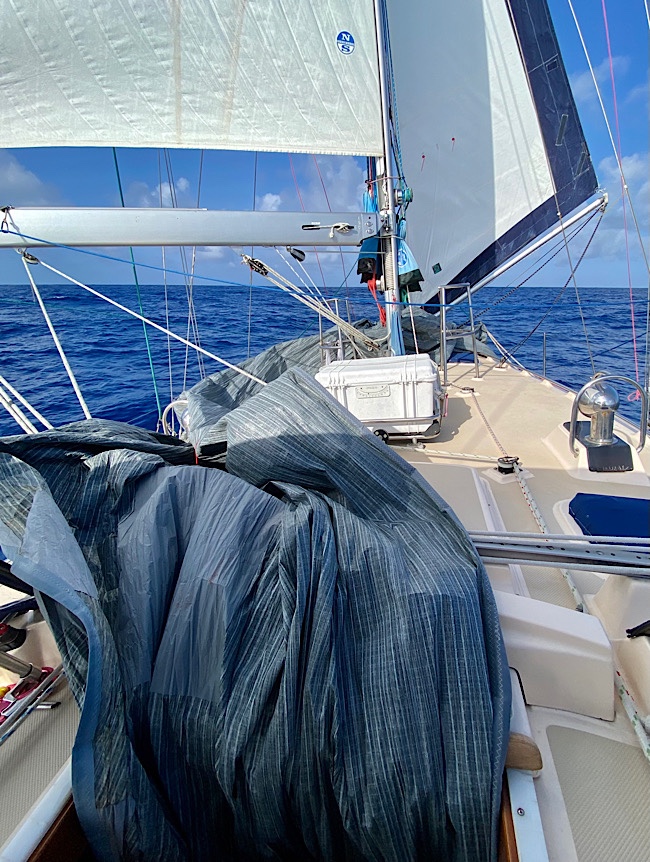
We had the code 65 sail up all day. The forecast was steady with light to moderate winds 10-12knots, we decided to keep her up all night. After the sunset, around 8pm, the waves increased a little (3-6ft.), causing the sail to frequently collapse, then she fell in water. This is the fourth time this sail has fallen down into an ocean. The swivel at the top of sail is sewed to the sail and the stitches broke. Dan was able to get the sail out of the water, tied it down for the night.
Monday October 25, Day 3 – Total nautical miles traveled 311, 143 nautical miles traveled in the past 24 hours.
This mornings job, spread out the sail to dry, then roll it up and put it away in its sail bag.
The spindle that furls the sail from the top was sewed to the straps. The brown color is oil that leaked out of it.
Tuesday October 26, Day 4 – Total nautical miles traveled 482, 171 nautical miles traveled in the past 24 hours.
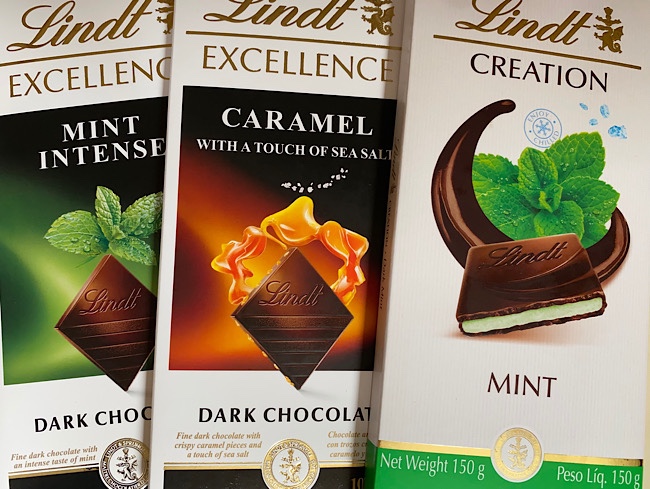
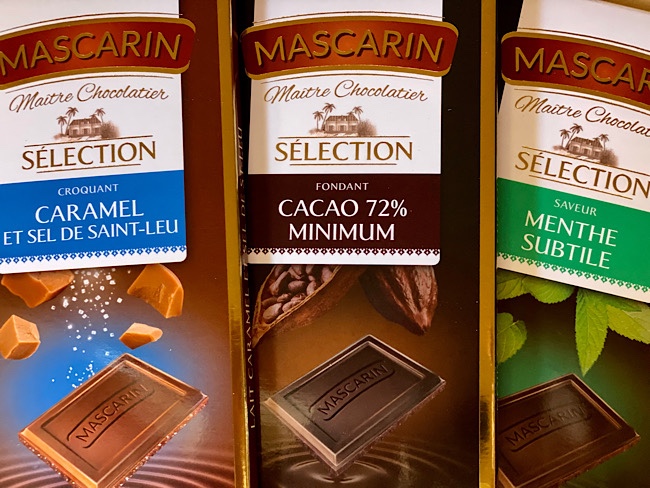
Our chocolate tradition continues. This brand is made on Reunion Island and is the the most popular chocolate there. Tuesday and Thursdays are chocolate days!
The equatorial current splits around the northern end Madagascar. We are in a northerly breeze on the southeast corner of the island and riding in about 3 knots of favorable current with the wind. Averaging 8-9 knots of speed over ground, occasionally hitting 10 knots. Both the main and Genoa are triple reefed. After midnight the wind and waves calmed down considerably.
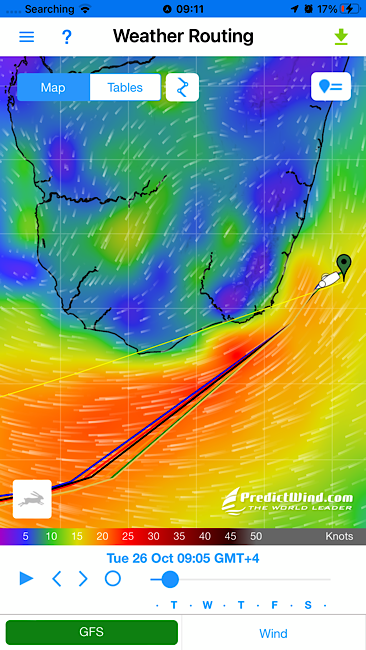
Wind is coming! We are in a hurry to get around the bottom of Madagascar before the forecasted strong southerly winds develop. As a result we had the engine running overnight to help keep the sails at the desired pace of 7 knots minimum as the winds were light.
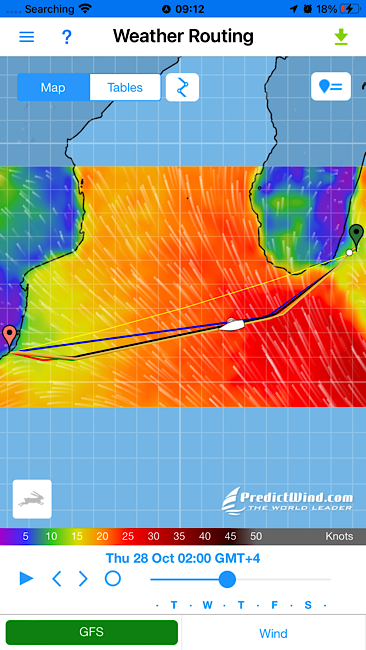
Forecast models with suggested tracks, the red is the more intense wind
Wednesday October 27, Day 5 – Total nautical miles traveled 655, 173 nautical miles traveled in the past 24 hours. A high pressure system is crossing the bottom of Africa is bringing strong winds up the Mozambique Channel, the water between Madagascar and Africa.
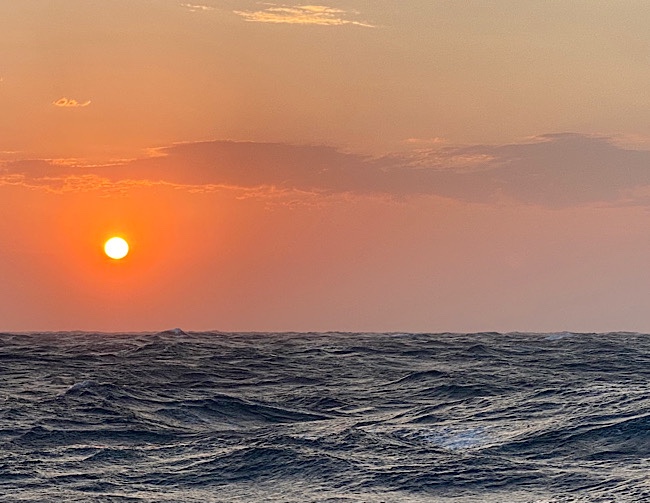
The big wind has arrived! Forecasted wind from the high pressure system is 25-35 knots. I’m sure that’s what we have (we were unable to get a replacement part for the broken wind indicator in Reunion Island). Sails are both triple reefed, cruising 8-10 knots with 2 knot of adverse current, 12-14 ft waves. We bore away 30 degrees from rhumb line to alleviate boat heal. Not a pleasant sail. It was a horrible 18 hour sail!
In preparation for this wind, Monday I made a cold tuna pasta salad in anticipation we were not cooking, that’s what we had for dinner. When the seas are rough I basically refuse to cook. Plus I think it’s too dangerous to have an open flame when there is this much movement of the boat.
Thursday October 28, Day 6 – Total nautical miles traveled 853, 198 nautical miles traveled in the past 24 hours.
Welcome to the fun house! That’s what this ride feels like. Pick up the fun house toss it around while squirting a fire hose at it. Speed over ground 8-9 knots, sails are more than triple reefed, the waves are still 9-12 feet, glad I don’t know what the wind speed number really is! By 8pm, the high pressure system had past along with the high winds.
New time zone GMT+2 12:15 pm in Richards Bay, South Africa, 6:16am in Philadelphia, Thursday.
Friday October 29, Day 7 – Total nautical miles traveled 1030, 177 nautical miles traveled in the past 24 hours.
Pleasant day with warm sunshine. Winds are 10-15, the “left over” big waves have subsided leaving rolling waves at longer intervals.
The nights have been quite cool, temperatures in the high 60’s. We’ve been wearing long pants, sweatshirts and socks with boots!
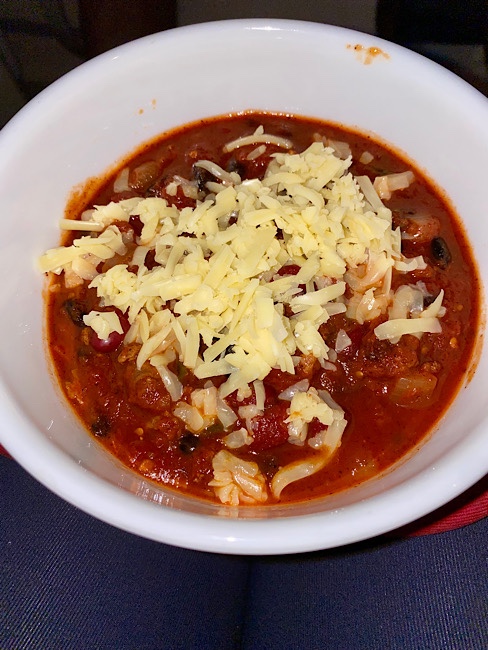
Chili for dinner, topped with an aged British Cheddar Cheese to warm us up!
Saturday October 30, Day 8 – Total nautical miles traveled 1191, 161 nautical miles traveled in the past 24 hours. Wind 15-20 knots, cruising speed around 8 knots.
As predicted, at 6pm the wind shifted from northeast to southeast. The main and staysail are in tight, for motor sailing, the breeze is light and at our nose. The wind is forecasted to go south. At this point, we are 137 miles from the destination.
Sunday October 31, Day 9 – 🎃 🦓🦒🐘🦏🐅🦛Day 9 – Total nautical miles traveled 1354, 163 nautical miles traveled in the past 24 hours.
We successfully crossed the Agulhas current flowing 2 knots where we were. A waypoint was set north of our destination while crossing it, to avoid drifting too far south and have to sail north against it.
Agulhas current is a warm water current that runs south along the east coast of southern Africa, and is the Western Boundary Current of the South Indian Ocean. It is narrow about 60 miles wide, and fast moving averaging 0.5- 2 knots per hour can reach as high as 5 knots per hour. It is one of the largest western Boundary Currents in the world.
Arrived at the “wall”, International Quay at Tuzi Gazi 4:30 pm. Confined to the boat till after a negative COVID test. There are two other boats on the wall and a submerged sailboat. Total trip time 8 days, 8 hours, 1411 nautical miles traveled from Reunion Island.
Richards Bay started out as a small fishing village located in the KwaZuku-Natal province. Named for Admiral Sir F. W. Richards, a commander of a Britian Naval Division. Formally known as Mhlathuze lagoon he renamed it after himself. The bay was used as a temporary harbor during the Anglo Boer War of 1879, opposition to British rule was a cause of the war.
Richards Bay has the largest export coal terminal in the world. 65 million tons are exported every year from the KwaZuku-Natal province.
KwaZuku-Natal is close to several World Heritage sites and Big 5 game parks. The Big 5 are Elephant, Rhinoceros, Leopard, Lion and African Buffalo because they the most dangerous and considered an accomplishment by trophy hunters to bring them home.
South Africa became an independent nation in 1961.
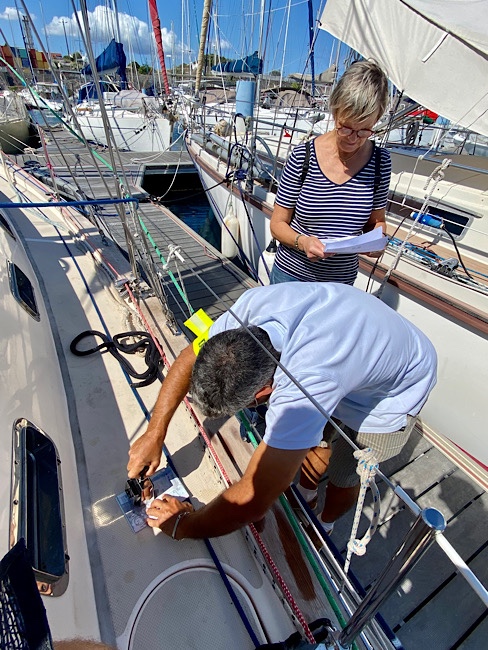
On the Indian Ocean crossing we discovered two water leaks in the boat which turned out to be coming in from chain plates. Standing rigging (shrouds and stays) which hold up and secure the mast, are connected to steel strapping attached to the hull. This support system is called chain plates. Dan, with my help, removed the cover plates on the rail, dug out the old material, then replaced with new. This product is flexible allowing for movement. A three day job!
Friday October 22, final trip to the Carrefour for provisioning. Customs should arrive on our boat tomorrow morning,
Friends we met in Fiji arrived here today, s/v Estran, Oscar, Philippine and their children Baptisine, Victoria and Maxene. They are from Belgium. Great to see them again, they will also be going to South Africa after some boat repairs. Hope to see them there too.
Saturday October 23, departure day. After 24 days on this beautiful island, it’s time to sail west. We are off to Richards Bay, South Africa. This 1,350 nm passage is expected to take about 10 days… and will complete our Indian Ocean crossing.
Note: On this page, there will be periodic blog post entries along the way.
You may send an email message while we are at sea to: trance@myiridium.net Note: text only email message, i.e.: no attachments, no photos, no signature images, etc.
Here next to the marina is the French ship Marion Dufresne, based in Reunion Island, is one of the largest research vessels in the world (423 feet) and covers all oceanographic fields except fisheries. She is also utilized as as a supply, cargo and fuel ship. Additionally there is an aircraft landing pad for helicopters. The ship serviced the France’s Antarctic Overseas Territories.
Wednesday October 13, produce shopping at the farmer’s market this morning in preparation for leaving within the next 5 days. We also turned the boat around, stern in as we are having a few areas welded tomorrow, this way the equipment needed can be on the dock.
We found out later in the day that they don’t allow welding in the basin. We’ll have to take Trance over to the municipal dock around the corner, where it is allowed.
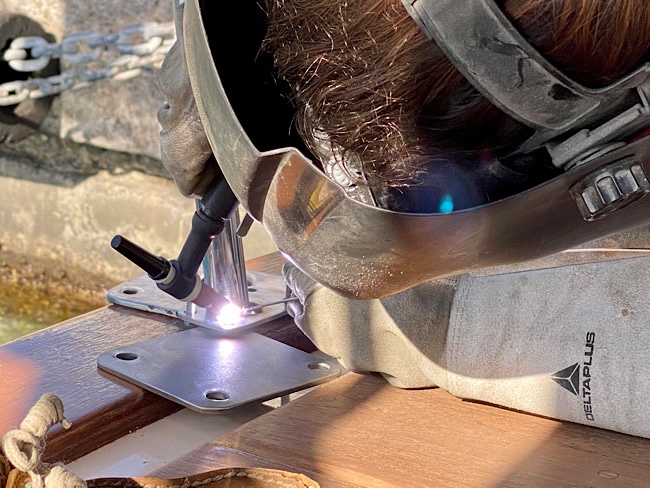
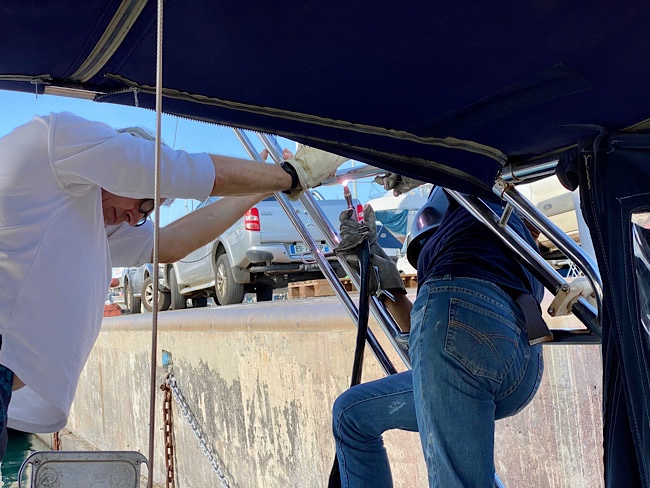
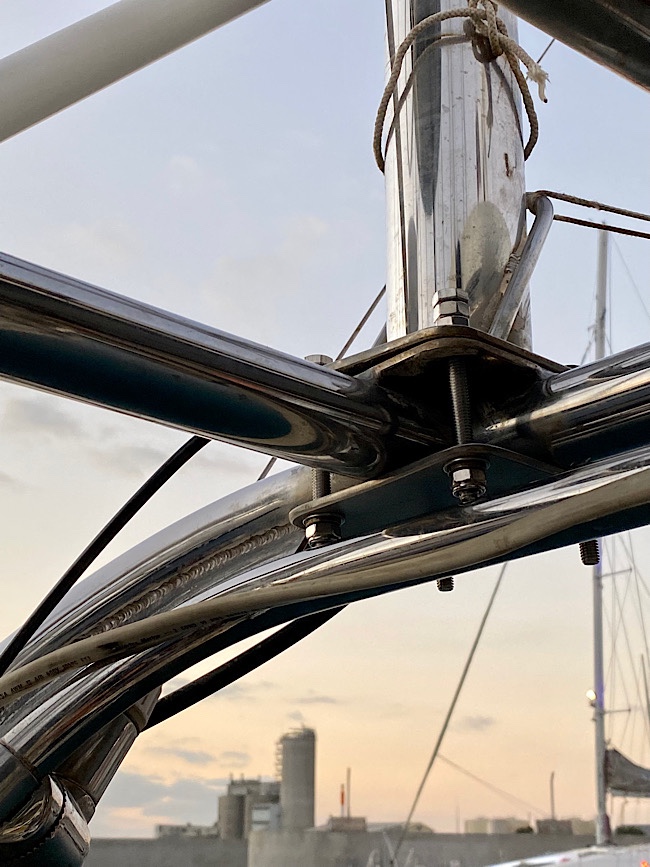
Thursday October 14, Trance got welded today. We had three stainless steel welds that failed when crossing the Indian Ocean, the stern pulpit at the gate, the wind generator mount and the mount that lifts the dinghy motor.
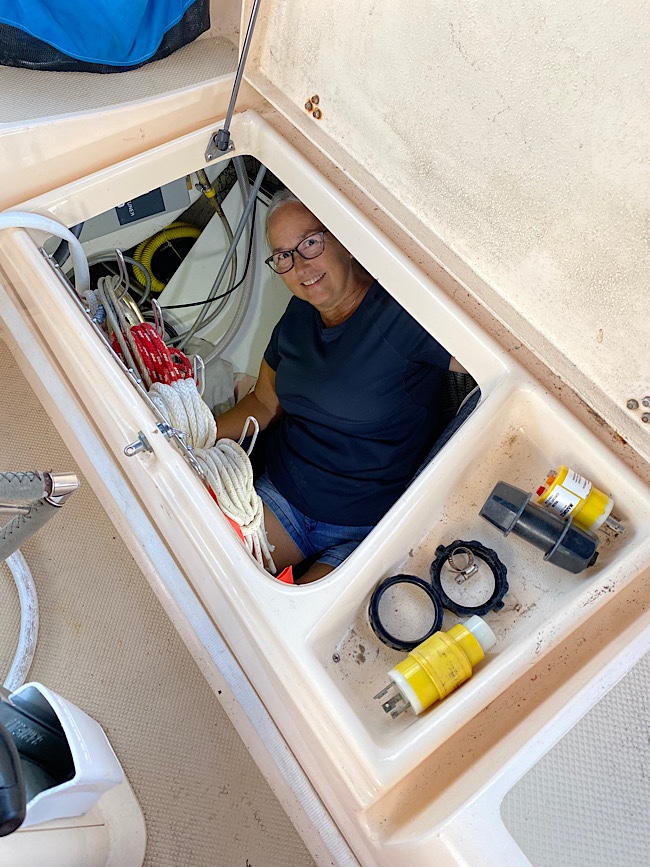
After the welding was completed we returned to our slip in the marina. The welder had fabricated two stainless steel plates for us, these we put on the bottom as extra stability for both the wind generator and the the radar mounts. I did my first “lazarette dive”, to pull down the wires for the wind generators as Dan attached it to the pole.
Friday October 16, We attended a going away party for Yann who is leaving on in his little red boat, Monday for Richards Bay, South Africa. Everyone brought hors d’oeuvre, drinks and there was some home brewed beer also. We met lots of wonderful sailors. The party was on the dock by the public boat work area. When it started the rain the tables and people moved under a large catamaran that was on the hard.
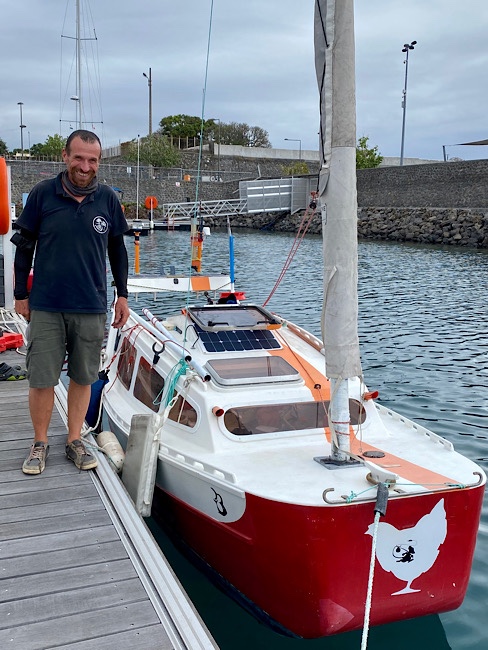
Yann and Dan
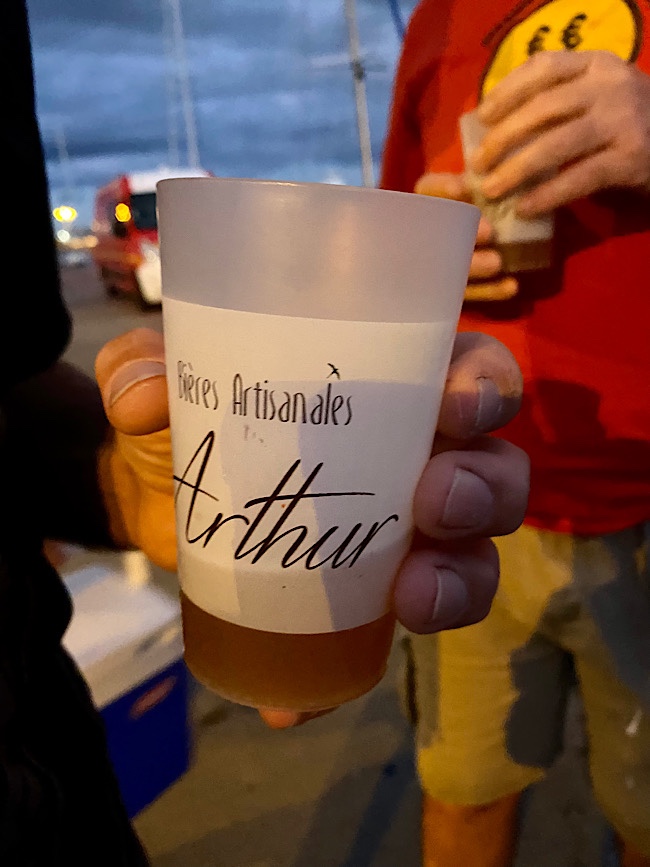
Home brew bi Arthur
Aure’Lie and Gilles
Yann, Gallice, Francois, Didier, Dan, Me, Magaly and Tristian
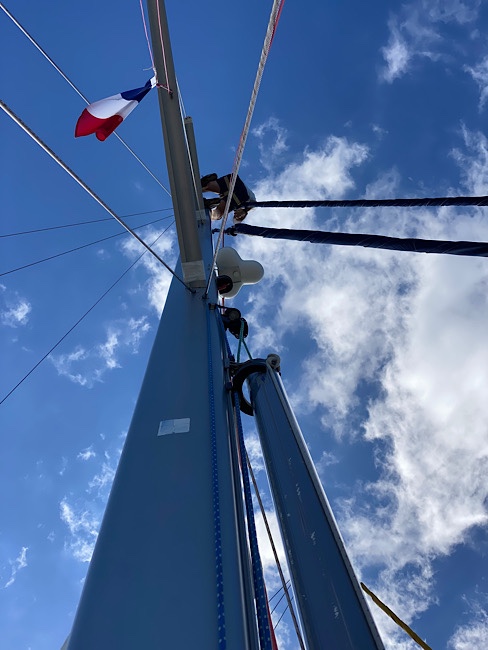
Saturday October 16, Dan went to the top of the mast with help from Didier, to re-thread the Genoa halyard that broke. Our spare halyard used to do this has too much friction for me to to hoist Dan, so we always need to find someone stronger to help. Next time the mast is lowered this issue will be investigated. Our to do list almost completed!
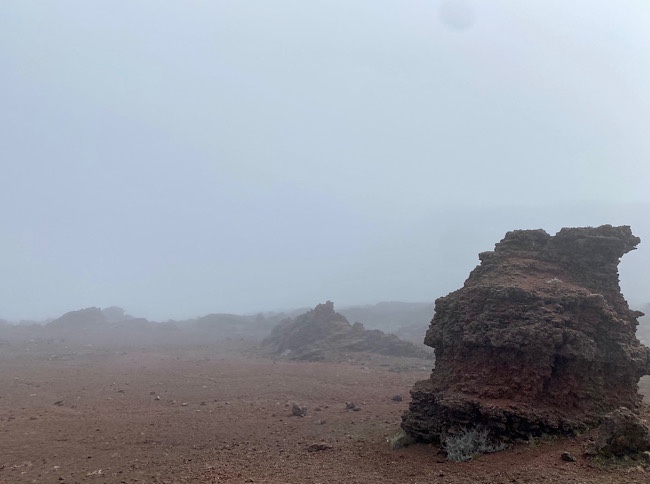
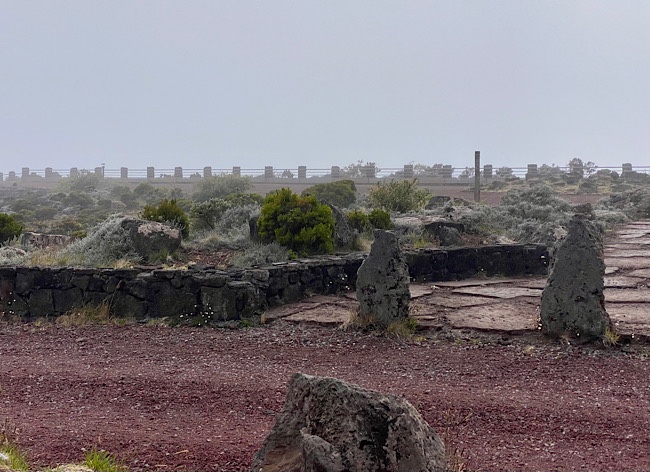
Sunday October 17, together with Magaly and Didier, we drove to an observation point, high on the north side, for the volcano Piton de la Fournaise, 8632ft high. For the past 10 years it has erupted about every 9 months, the last was In April 2021. It is the most visited attraction on Reunion Island. When we arrived the cold fog and mist rolled-in leaving the crater unseen.
There are several educational hiking trails throughout the caldera, as well as tent camping areas.
Red pin is the elevated lookout area
Caldera
Our view of the foggy crater
Walkway at the rim
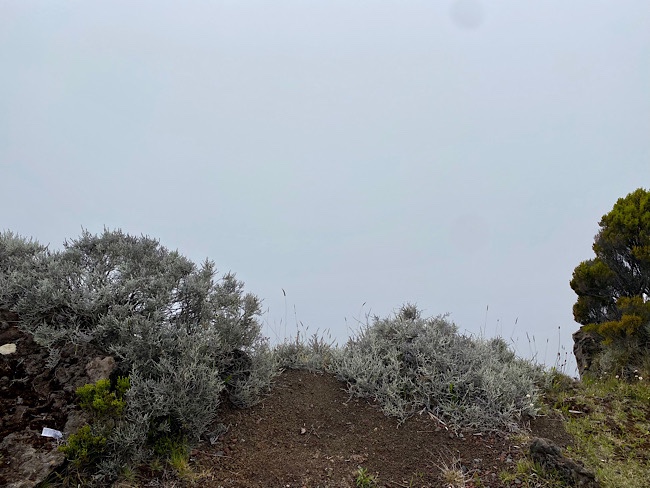
The vegetation
Road through part of the crater
This river was formed by the first collapse of the volcano 300,000 years ago
Didier and Magaly
From a previous eruption
Monday October 18, waiting for a weather window to sail to South Africa. There is not much wind here right now, but too much predicted wind 7 days out near South Africa.
Laundry day.
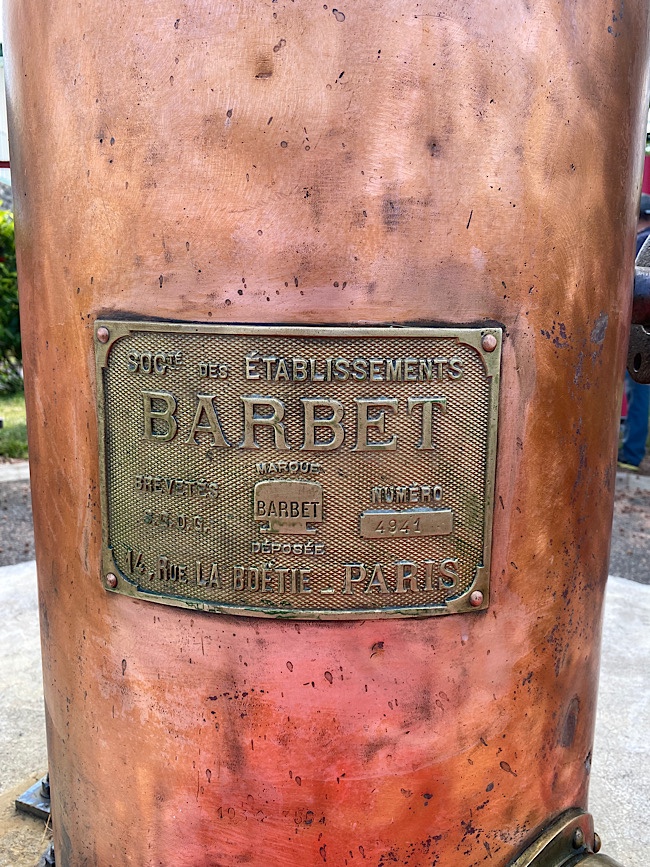
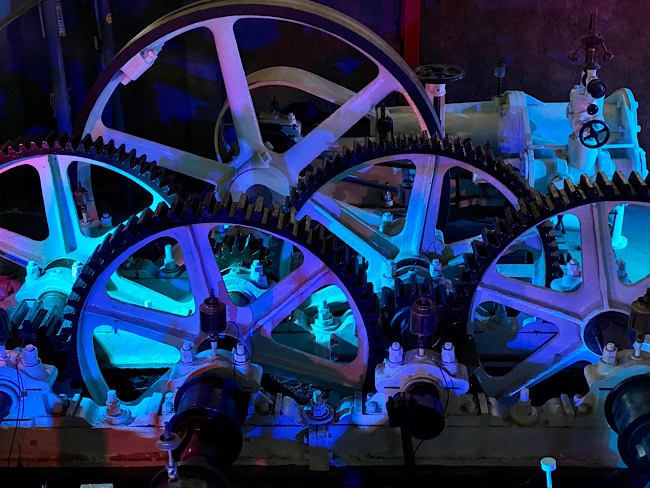
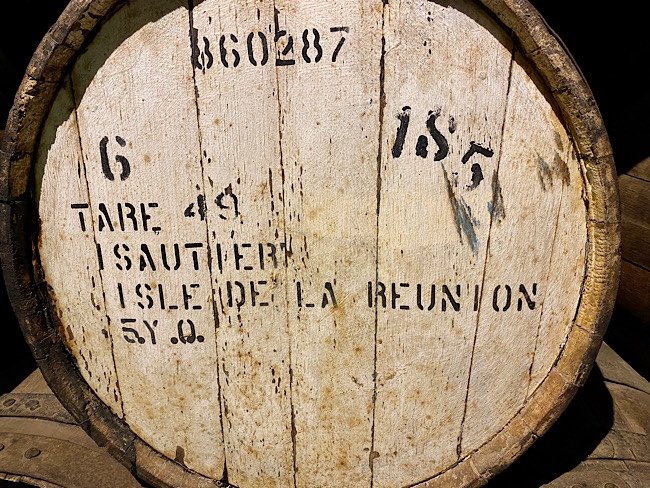
Tuesday October 19, Road trip to Saint-Pierre to La Saga de Rhum. The Isautier rum museum and factory. We took a self guided tour of the museum ending at the tasting room where we sampled various rums.
In 1845, the Isautier family business was created. It is the oldest rum distillery and oldest business on Reunion Island, producing award winning spirits in international competitions around the world.
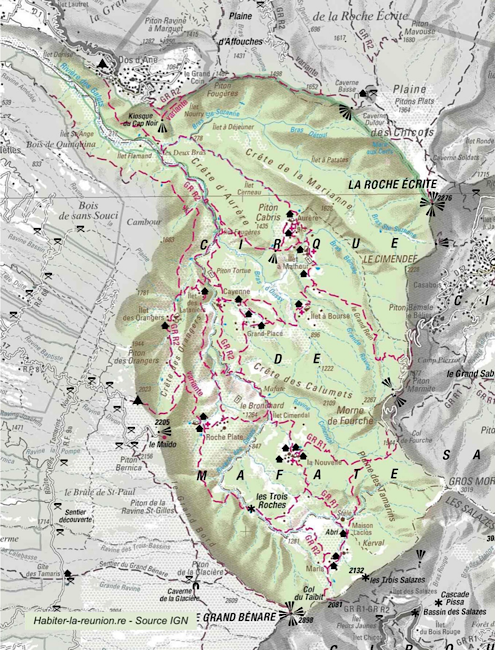
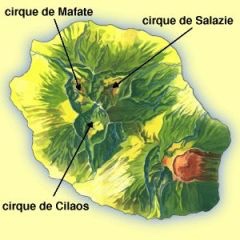
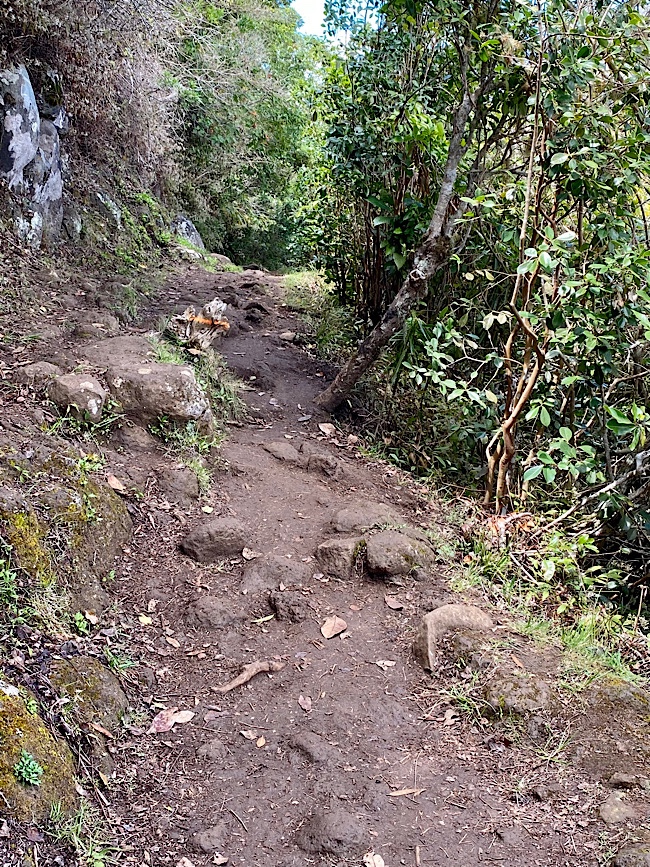
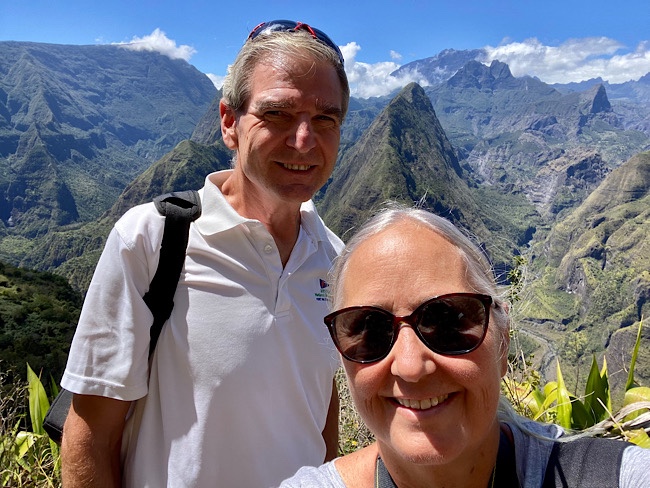
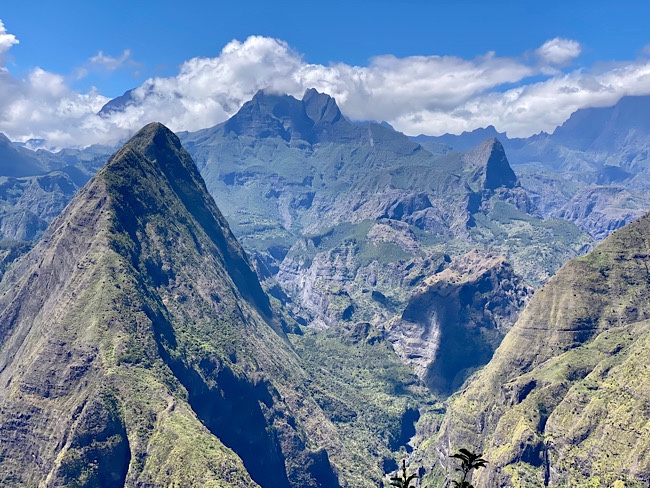
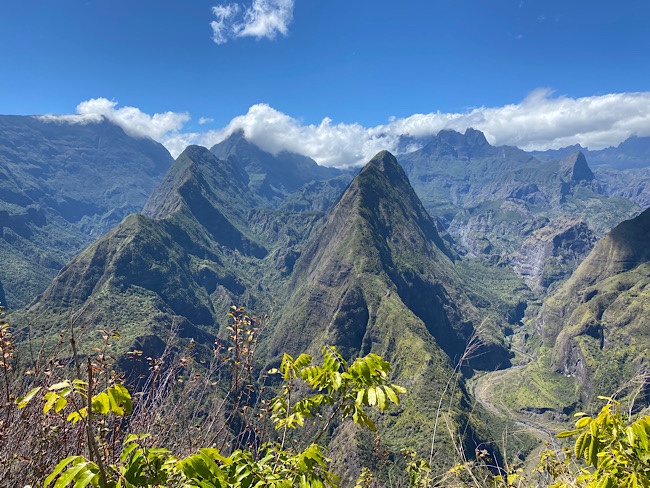
Sunday October 10, The Cirque de Mafate is a caldera, a large cauldron like hollow that forms shortly after the emptying of a magma chamber in a volcanic eruption. It was formed from the collapse of a large inactive shield volcano the Piton des Neiges. It is 10,069 feet tall, the highest point in the Indian Ocean. There are over 90 miles of hiking trails in the cirque. Together with Magaly and Didier we hiked a short trail to a lookout.
Later we all went to the Le Jardin des Tortues, The Turtle Garden. It’s a private collection of turtles and tortoises. We even fed the large tortoises.
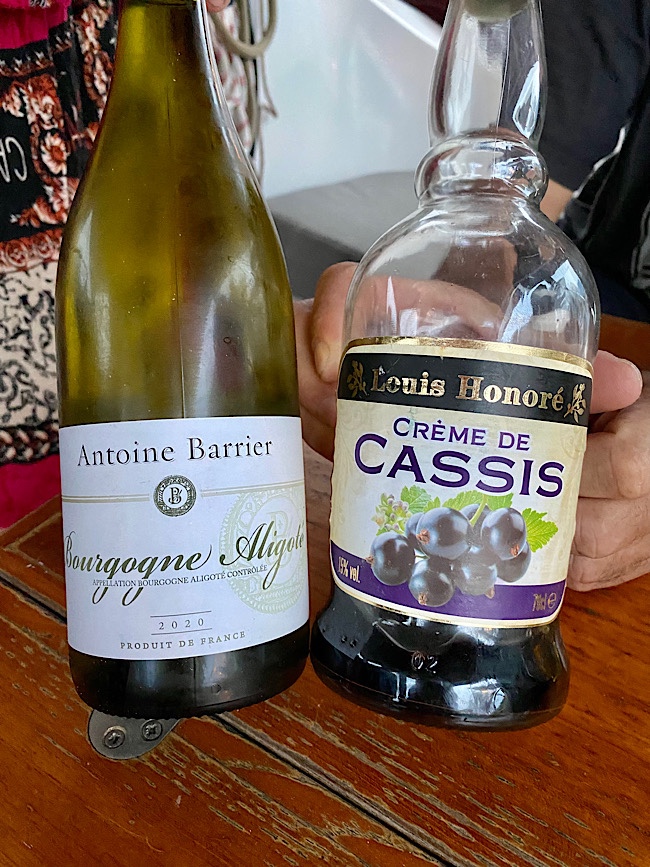
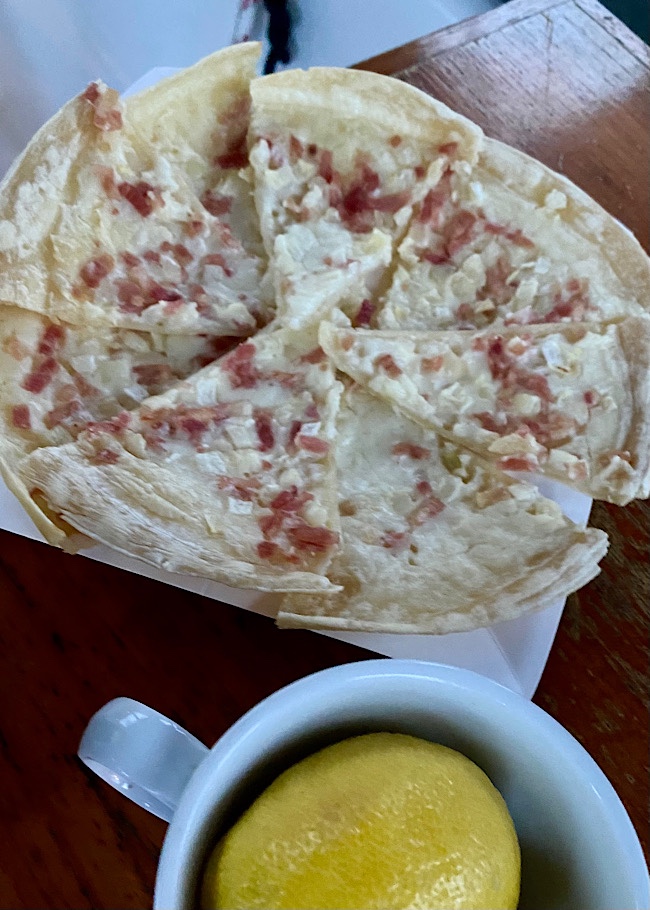
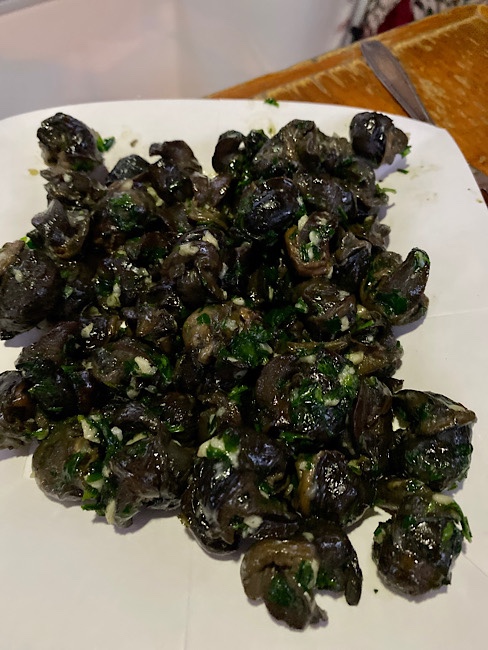
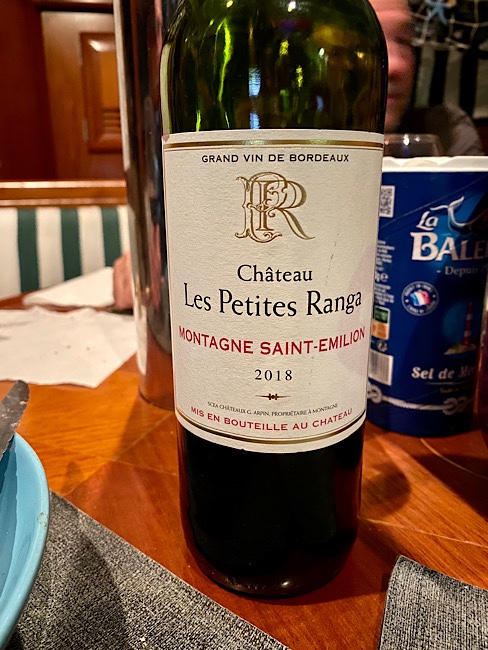
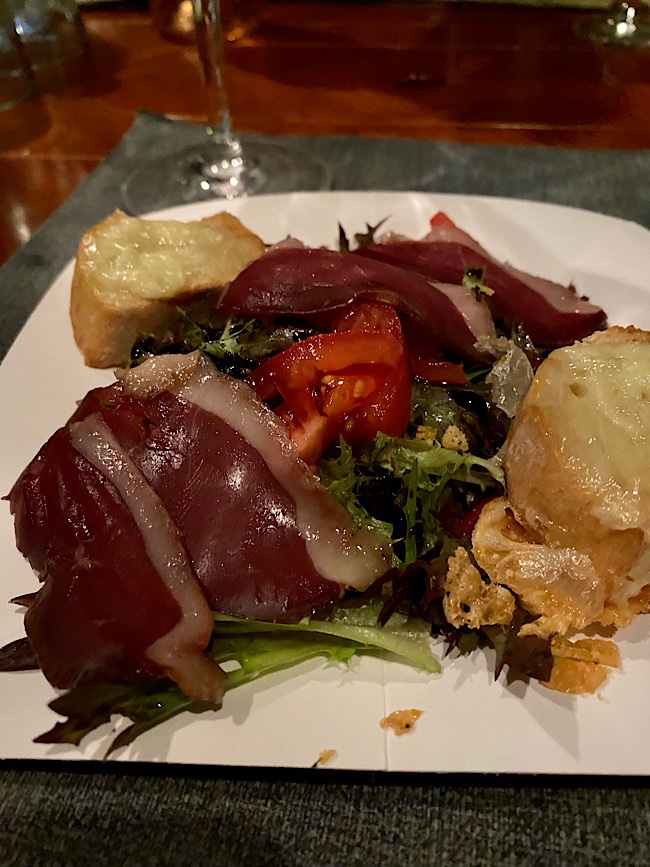
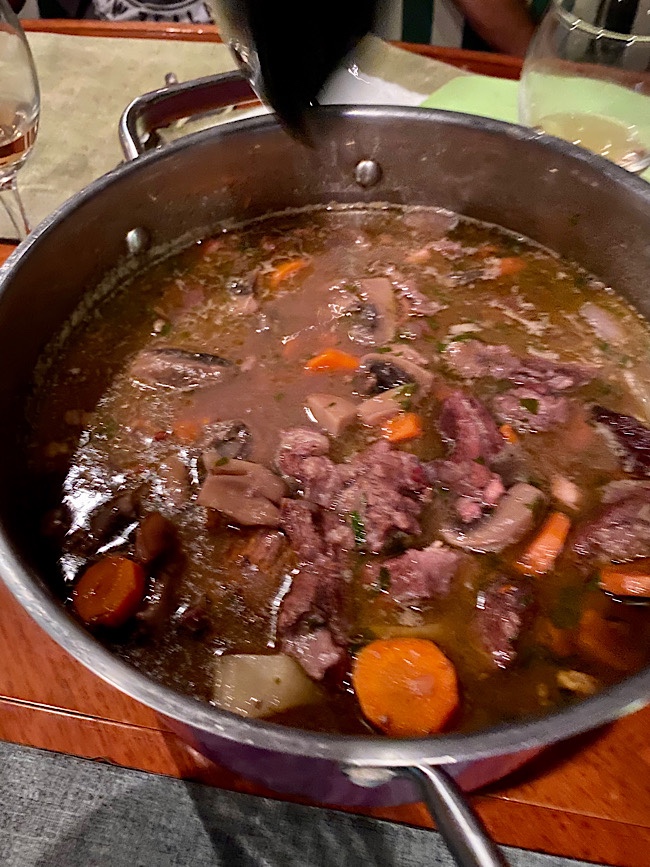
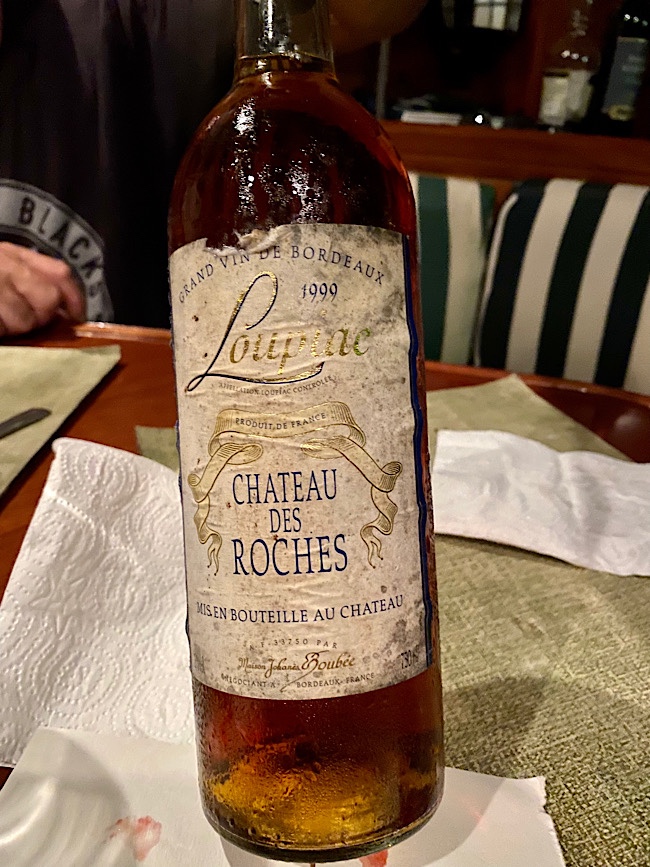
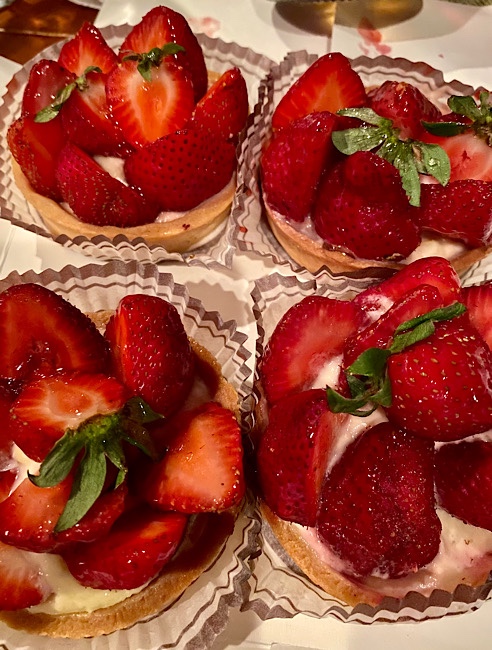
Monday October 11, Magaly and Didier invited us to dinner on their boat. She cooked an authentic French meal for us. For starters, there was Quiche Lorain, Flammiche and Escargot cooked with butter and garlic served with Kir, a French cocktail, a combination of Crème de Cassis topped with Bourgogne Aligoté, a white wine. The second course, Salad with Duck bacon and Rocamadour cheese on baguette slices. Beef Bourguignon was the main course, served with a 2018 Montagne-Saint-Emilion, a red wine blend. For dessert we brought Strawberry Tarts, served with their 1999 Loupiac Chateau des Roches, a dessert wine.
Magaly and Didier
Together they make Kir
Quiche Lorain
Flammiche
Escargot
Salad with Duck bacon and Rocamadour cheese on baguette slices
Beef Bourguignon
Strawberry Tarts
Tuesday October 12, we met Yann Quénet. A French sailor who is circumnavigating in s/v Baluchon, a 4 meter (13 foot) boat he built. Hyperlinked to his name is an article about him. When in Panama, his boat was too small to transit the canal, so it was transported across by land.
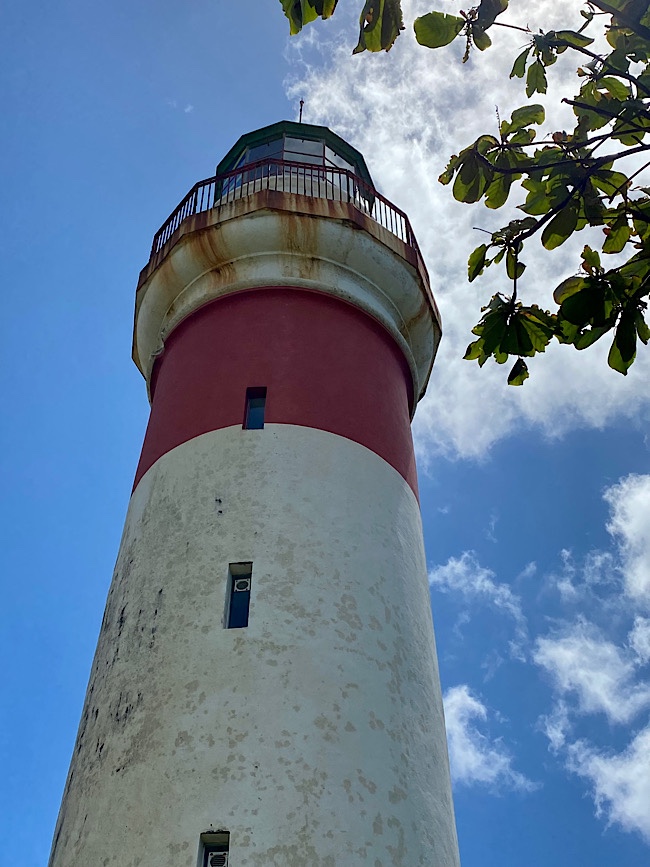
First stop the Bel-Air Lighthouse. Built in 1845, it was the first and still is the only lighthouse on the island.
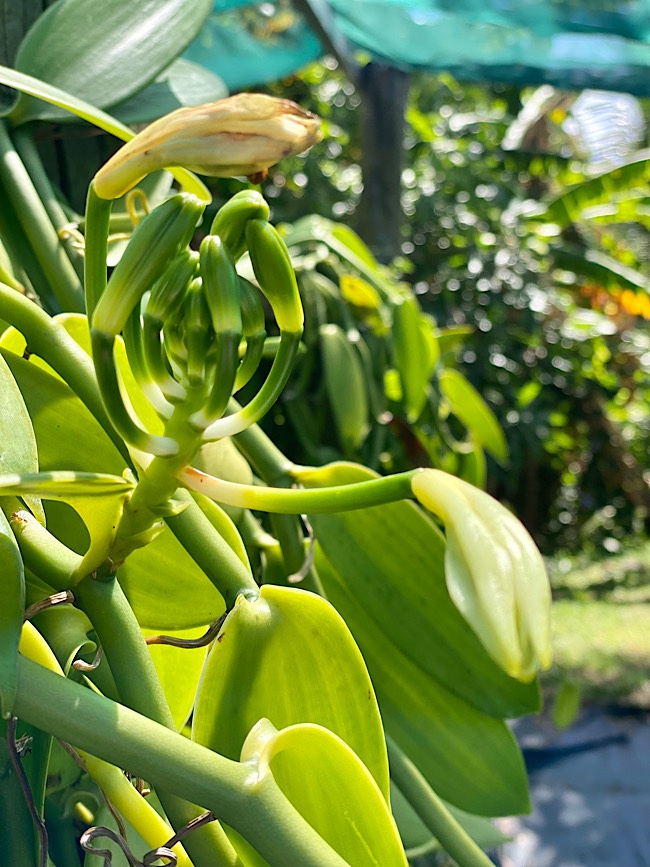
Next stop, La Vanilleraie Plantation. Vanilla planifolia, a species of vanilla orchid, is the primary source of vanilla flavoring. This plant is native to Mexico, Guatemala and Belize. First introduced in Reunion Island in 1819, however they struggled to thrive because the bees that naturally fertilize the plants do not exist on Reunion. A method of hand pollination was discovered and is still used today. With this discovery, Reunion became the leading producer of vanilla in the world in the late 19th century, exporting 200 tons. Today there are more than 30 vanilla farmers.
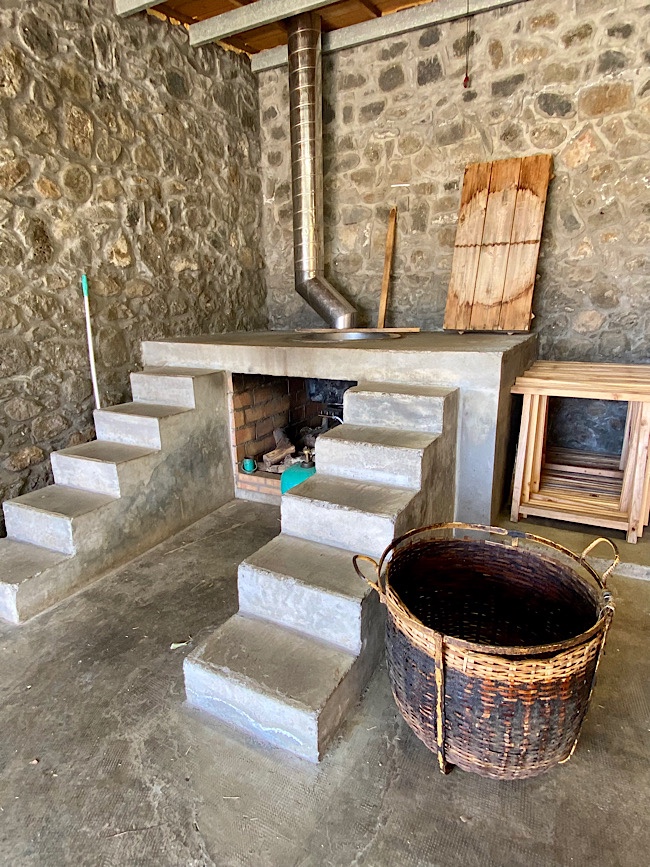
Vanilla pods are harvested when a yellow color appears on the bottom of the tip. To prevent the pods from splitting and loosing their flavor, they are blanched in 149 degree water for 3 minutes. A basket is used to immerse the pods in water. Quickly drained pods are placed in storage chests lined with blankets for 24 hours to make them sweat. This steaming process stage will make the color change from green to a chocolate color. Drying the vanilla begins outside with sun drying for about two weeks, the pods are then placed on racks indoors for 2-3 months. The dry vanilla pods are then placed in teak storage chests for a year to mature.
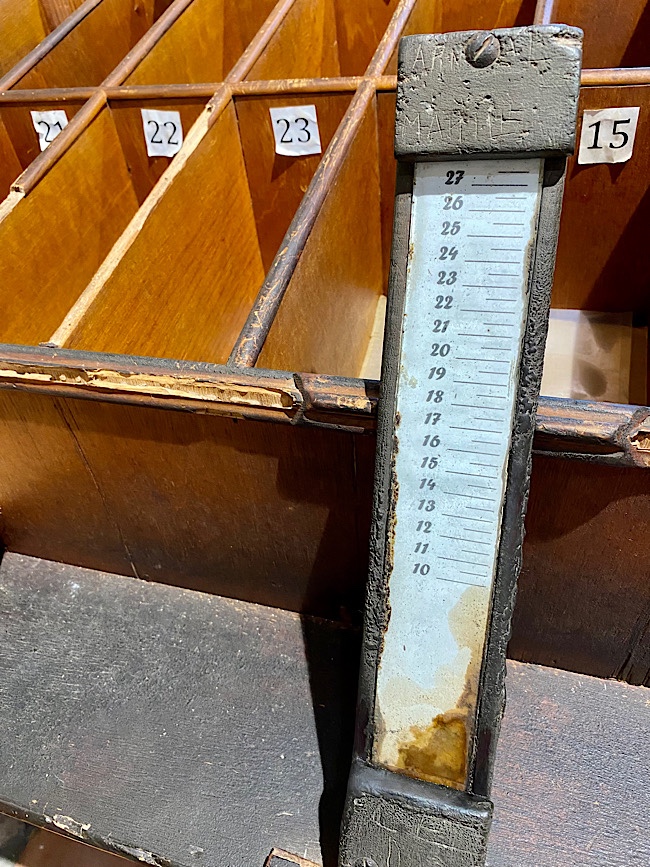
Sizing the length of vanilla pods, less than 14cm are considered inferior, classical lengths 14-19cm and gourmet is a minimum of 20cm.
Depending on where vanilla is grown, the flavor is different. Mexican vanilla is more of a chocolate flavor, Reunion has a prune flavor and Madagascar has a dry tobacco flavor.
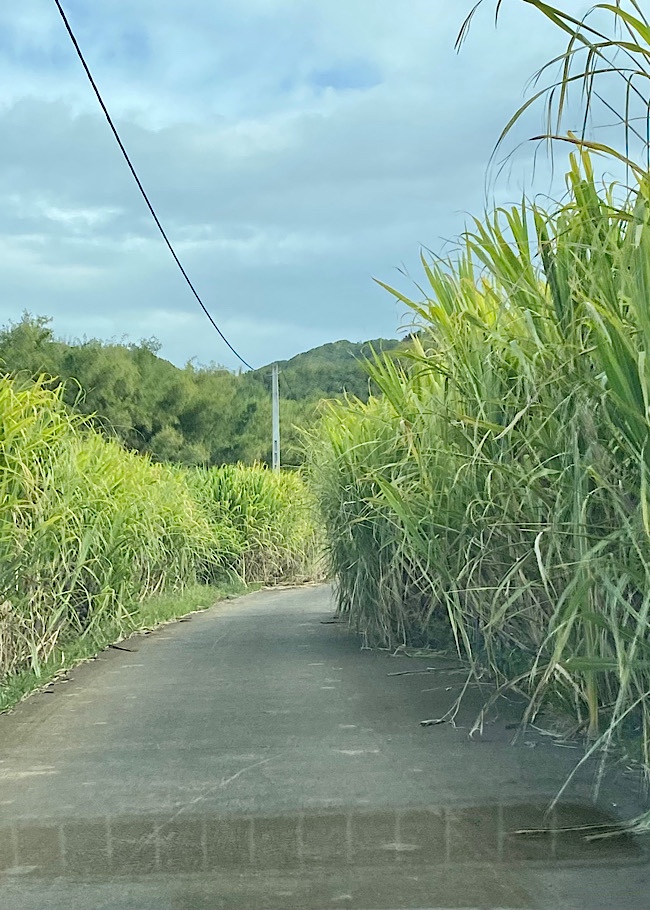
We drove down this road surrounded by sugar cane
Vanilla plants
The flower
Hot water bath for blanching vanilla pods
Area for drying
Drying racks
Teak storage chests
Drying vanilla
Vanilla pods are measured for pricing
La Cascade Niagara, The Niagara waterfall is formed by the waters of the Sainte-Suzanne River. At a height of about 82 feet, it flows into a pool where you can swim. A popular site for picnics, it is located in the middle of sugar cane fields.
Sundowners with Aure’Lie and Gilles, they are on a sailboat across from us on the dock.
Thursday October 7, trip into the capital, Sainte Denis. In search of the Camara shop to see if they can fix my Nikon or maybe buy a replacement. Their web site indicated the camera body I was interested in was in stock, only to find out it was in stock in Paris.
Next stop the Tourist Center. We picked up a map of Saint Denis, asked what places they would recommend us visiting. The car was parked and we went for a walk.
“Reunion to its children, heroes of the great war”. World War I memorial
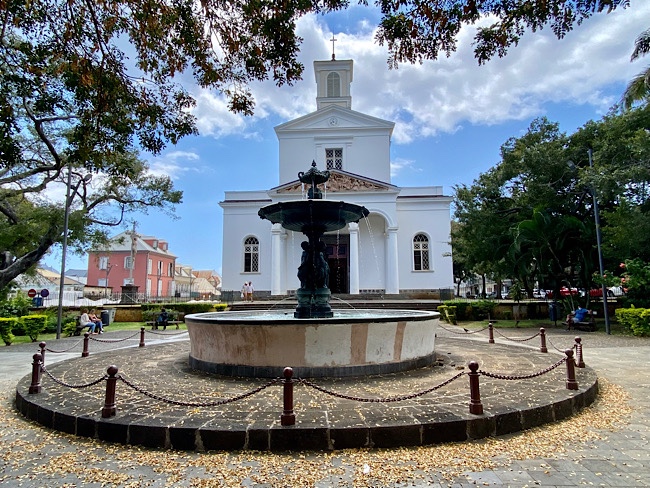
Saint-Denis Cathedral
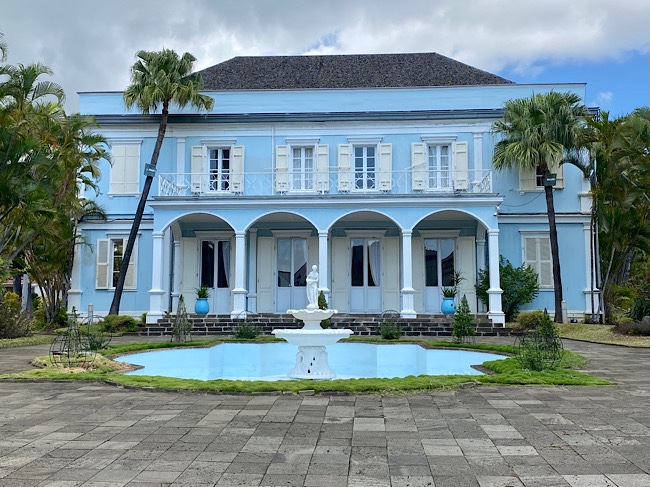
Built in the early 1790s by Jean-Baptiste de Lestrac, who was the first mayor of Saint-Denis now home to the Reunion Departmental Council
Pedestrian shopping street
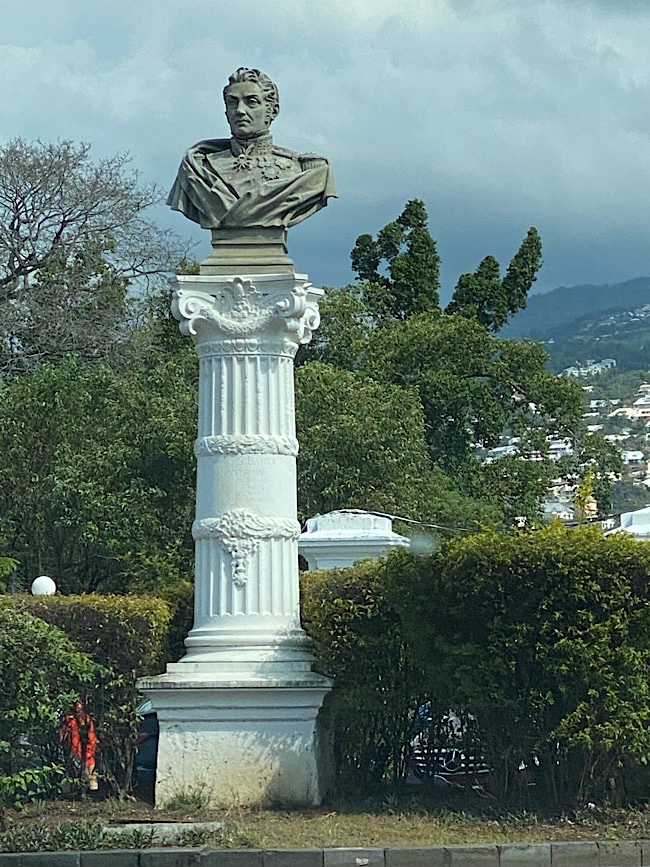
François Gédéon Bailly de Monthion (1776-1850) he was a Major General in the French Army. Born on Le Reunion Island.
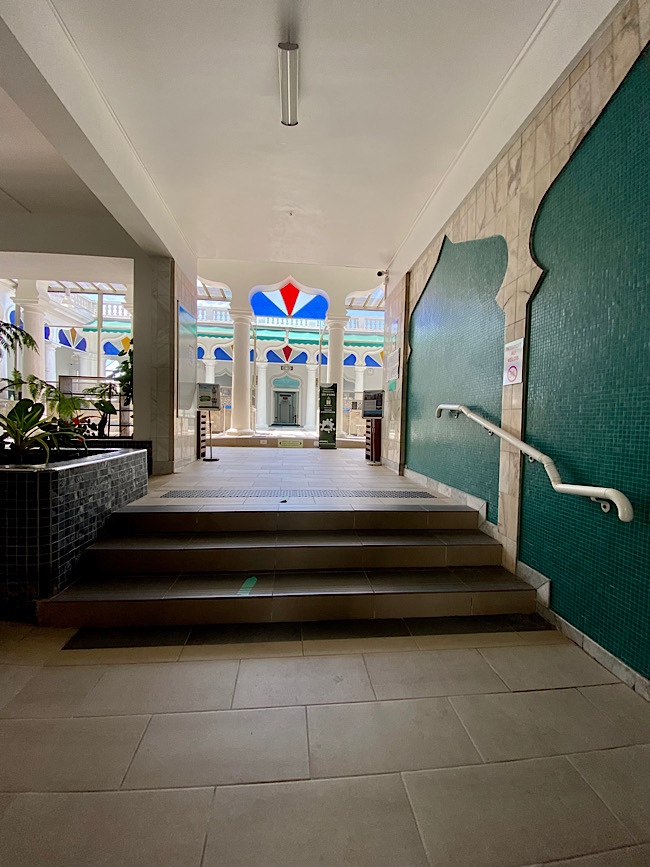
Grande Mosquée de Saint-Denis
The door was open so we looked inside
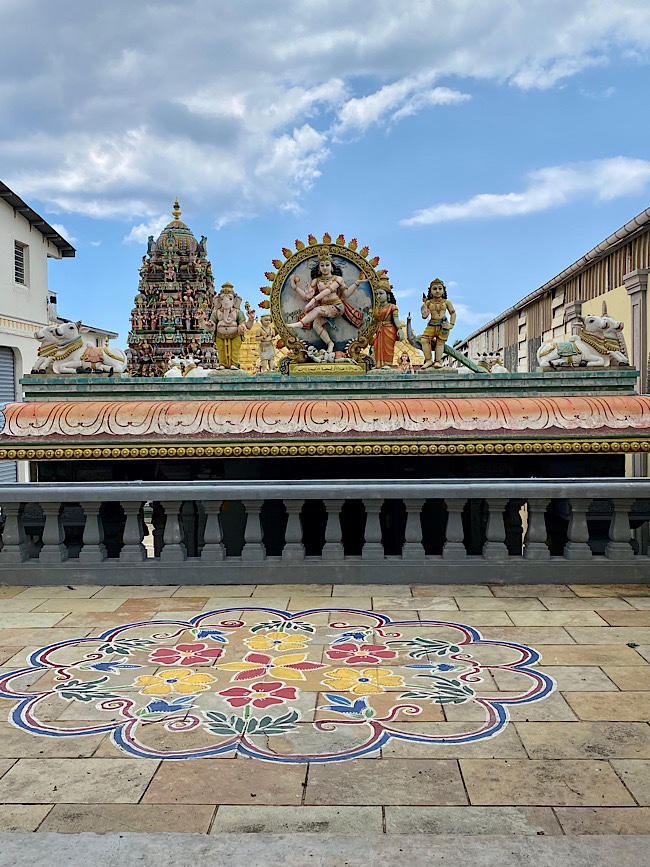
Hindu Temple Kalikambal
The door here was also open so we looked inside
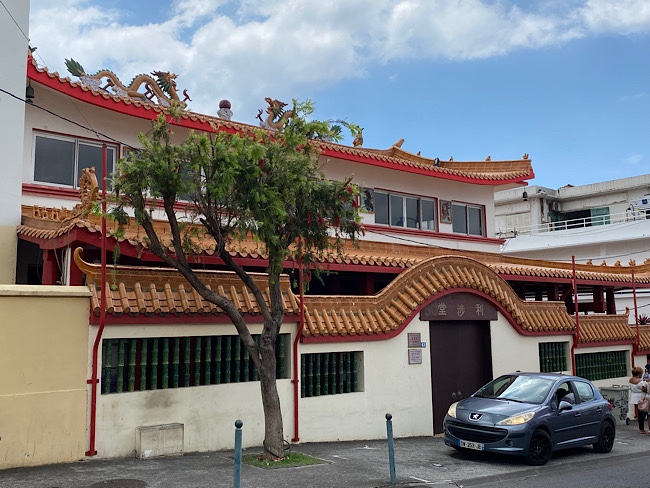
Chinese Temple of the Happy Crossing
Chinese Temple of Eternal Prosperity
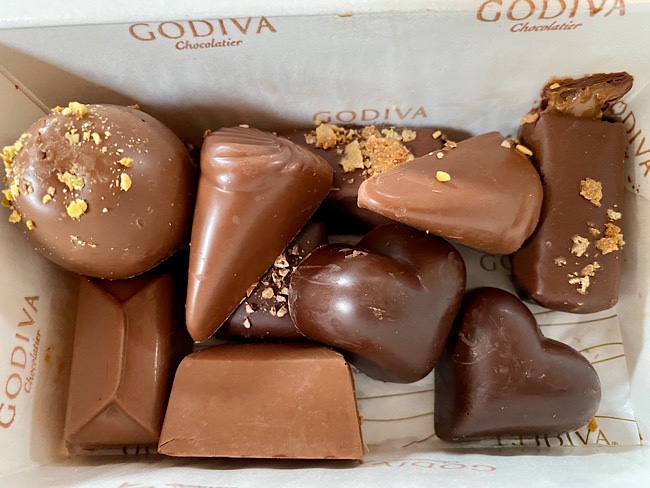
We bought chocolate!
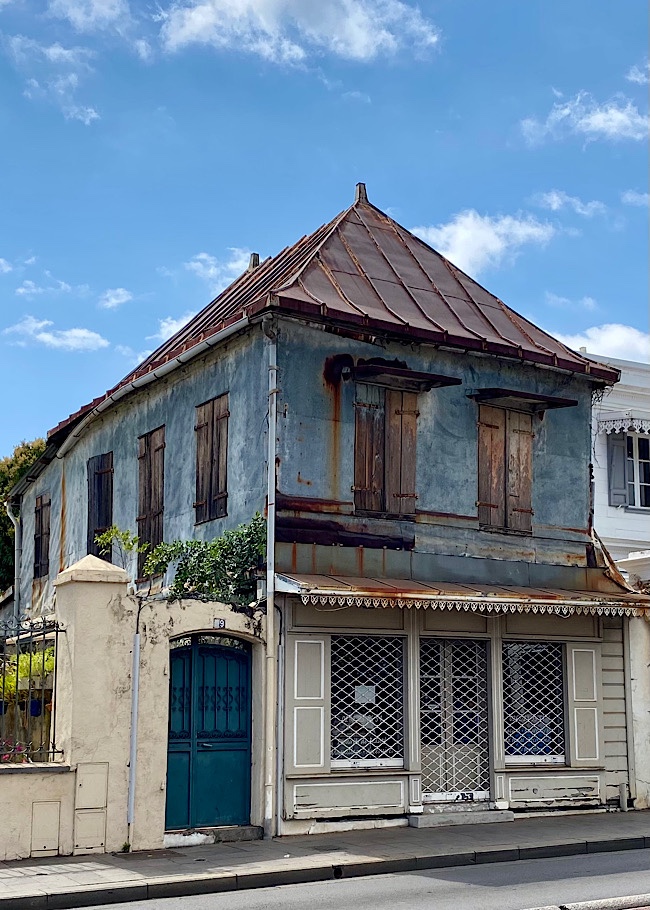
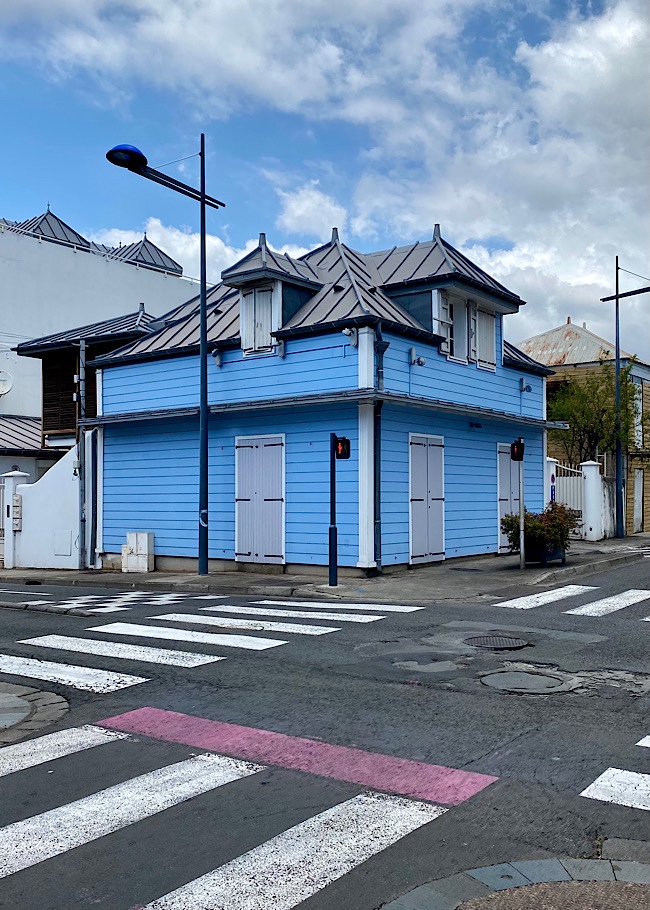
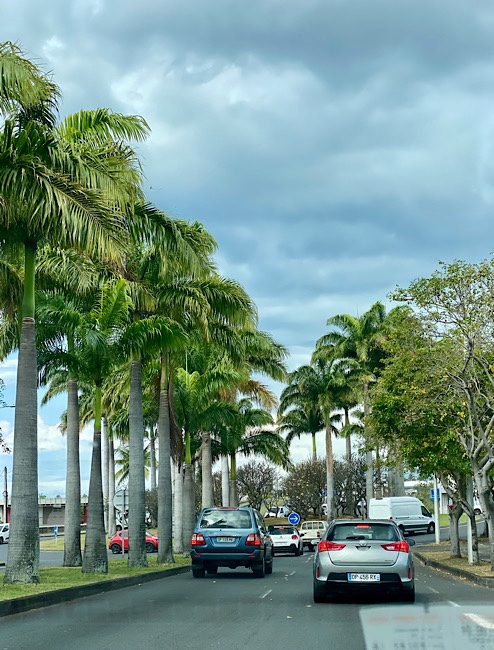
Random photos
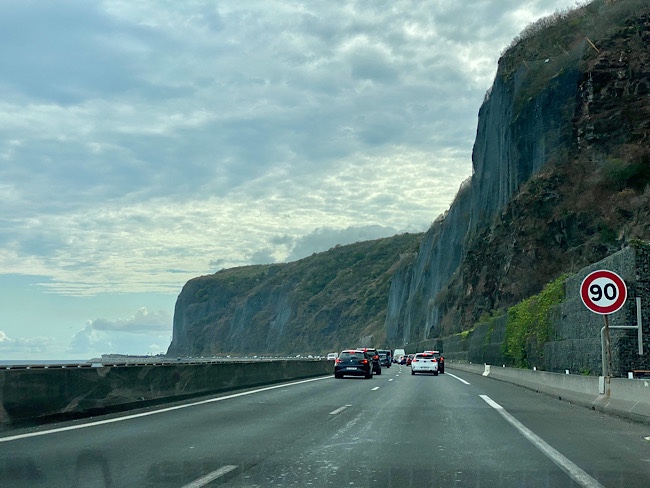
France’s most expensive road project
Highway N1 goes from Le Port to Saint Denis. There is a new road/bridge being built over the water it will be 6 lanes. The cliffs are rock covered in chains to prevent rocks form landing on the road. The new road is farther away from harm.
Friday October 8, Falbala arrived this morning! Great to see them again!
In the afternoon we took another trip to the Carrefour grocery store and took Magaly from Falbala with us.












































































 Sailing Trance